3 Feb 2025

Underwood Typewriter, a story by Carlos Mota


A Velvet Sofa and an Underwood Typewriter

by Carlos Mota


Link to Krzystof Pelc’s Story

After reading Green Velvet, by Krzysztof Pelc, the son of an Iranian émigré, I couldn’t help but reflect on the lives of so many migrants whose dreams have been deferred—or even irreversibly devastated—by Trump’s infamous and cruel executive order to deport them. The story’s themes resonated deeply, echoing the shattered hopes of millions who have sought a better life in a country that now turns its back on them.

I was reminded of an old Underwood typewriter my brother found on the streets of Manhattan shortly after he arrived in New York from Venezuela in 1970. He cleaned it and placed it prominently in the home he and his wife purchased eight years later. Though it was in perfect working order, he never typed a word with it. Instead, it became an object of beauty, sitting on a wooden pedestal in the middle of their living room, a small but potent symbol of transformation and pride.

My brother now lives in South Carolina in a smaller home purchased with the proceeds from selling his New York property and a South Carolina apartment he once owned. I imagine the typewriter still commands its place of honor in his new living room, a quiet reminder of how far he has come.

His two sons, who were born and live in New York, exemplify the opportunities once accessible to migrants and their children. His older son holds an MBA, while the younger one, a talented artist with several exhibitions to his name, earned a PhD in psychology. Their accomplishments evince the incredible contributions migrants and their descendants can make when given the chance.

The typewriter and the velvet sofa could symbolize the promise of America: opportunities seemingly lying on the street, waiting to be claimed by those who dare to dream and work for them. Yet, for so many today, that promise has been shattered. The country that once embraced its identity as a land of opportunity has erected barriers, shutting out the very people who continue to enrich it.

This reality is not unique to the United States. Watching a woman on Spanish television express her fears about menas—unaccompanied migrant minors—I was struck by how her concerns mirrored the prejudice and exclusion present across the Atlantic. She claimed these children threatened her community and would drain local resources, an argument that has long been used to justify exclusion, both in Spain and in America.

Possibly, in the eyes of Trump, his German grandfather and his Slovenian wife bypass the concept of unacceptable foreigners, much like unaccompanied Ukrainian children in Spain manage to avert the moniker of menas and are instead welcomed, supported, and provided with opportunities to thrive, opportunities that could just as easily be extended to others, yet are denied because of prejudice.

The Underwood typewriter and my brother’s life serve as reminders of what is possible when opportunities are accessible to all. But they also underscore the tragedy of shutting the door on those who come seeking that same promise. The green velvet sofa reminded me of the lives caught in this tension—those whose potential is stifled by systems that see them as “other.”

26 Jan 2025

James Salter's "Light Years" by Begoña Rodríguez


James Salter's novel “Light Years” 

in Adam Rapp´s play 

“The Sound Inside”

A Review by Begoña Rodríguez Varela


Light Years: James Salter (Penguin Modern Classics) : Salter, James, Ford,  Richard: Amazon.es: Libros

Source for photo here

A priori, James Salter´s novel´s title “Light years” brings to mind a time of intense happiness, a time when everything ran smoothly and looked bright. In fact, Vedra , the female protagonist of the acclaimed novel , is a handsome mysterious woman married to an architect ,Viri, and , seemingly, lives a gilded life. However, those shiny appearances contrast with frustrated ambitions and enervated passions. Also, the prospect that aging or a deadly disease may take one’s life in an instant leads them to make wrong decisions ….or not.

“All that glitters is not gold.” True. As the story unfolds, the initial picture of their idyllic life with their two children in a Victorian house by the Hudson river, where they host candle-lit parties and entertain very interesting friends, turns out to be fake. They are not happy together and, besides, they have love affairs. Interestingly enough, the characters appear to be performing on a revolving stage. We can see what their friends ignore. An upper middle class cultivated couple who think life is richer than what they have but lack that clear-sightedness to know exactly what they are looking for.

Contrary to what is expected, it is not adultery that puts an end to their marriage but the death of someone close to them. Then, Vedra decides to travel to Europe with the intention of becoming an actress while Viri , her ex husband, is much appreciated by his new colleagues in an Italian Architecture Studio and marries again..Deep inside frustration and depression creep in, though. Insightful snapshots of a Polaroid camera.

Indeed, Salter´s mastery of the language is shown in his storytelling , the lyrical descriptions of places and, above all, the dialogues, which give a real portrait of the characters.Like in Pinter's theatre, they show the unsatisfied and unsatisfying desire to find haven. A haven which cannot be found in the material, money or sex. Where else can they turn to, then? Maybe to “The Sound Inside.”

It is what Bella Baird in Adam Rapp´s groundbreaking play does, after learning she has got cancer. Initially, Bella, a Yale professor of Creative Writing and author of an unsuccessful novel, prefers Literature to real people. The power of intellect, the intense connection between the writer and reader is key in her life until her mother´s death, her deadly disease and the arrival of a brilliant student trigger a change of mind.

Life is absurd. Can Art, Literature, Theatre and Architecture make life meaningful? Is it professional excellence or is it the connection and real bond with special people that make our lives worthwhile?

Ironically, Viri and Vedra realize, at the end of their lives, that only the time spent with their children gave them some comfort, some happiness . Thereby, Viri regrets having sold their Victorian house by the Hudson river and comes back there after Vedra’s funeral. After all, it is this old house that conjures up pleasant memories of past light years.


20 Jan 2025

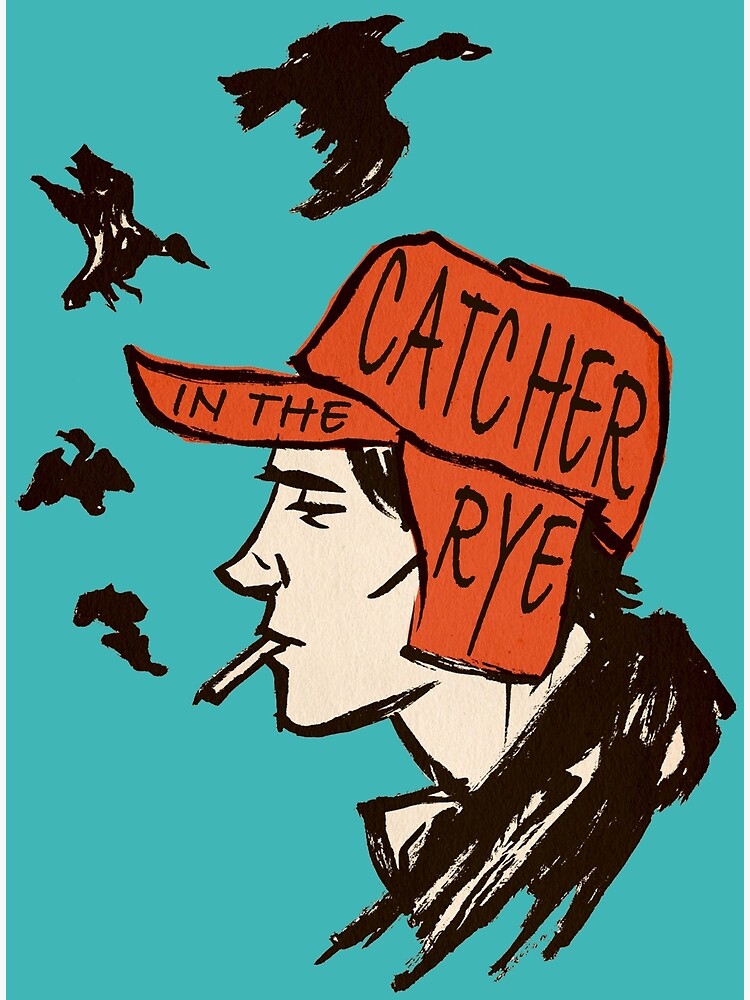
"The Catcher in the Rye" by J.D.Salinger

 “Growing Pains” in J.D.Salinger’s “The Catcher in the Rye”

Póster for Sale con la obra «Holden Caulfield, Catcher In The Rye» de  mindesigner | Redbubble

Source: here

Holden Caulfield ushers us into the story of his life: “If you want to hear about it” no problem”, but warns that he will not follow the line of that “David Copperfield’s kind of crap.”

Having a look at the first chapter of Charles Dickens’s “David Copperfield,” a first-person narrator details the precise hour of his birth, day, and circumstances: Friday, midnight, dispossessed, and with a caul that was bid for. Begoña brought the interesting meaning of “caul” a membrane that covers the newborn’s face and body, a case occurring once in 80, 000 births. A symbol for protection? The sage ladies have prophesied David’s unlucky destiny as well as his gift to see ghosts and spirits, a flair all “unlucky children” have according to David. 

Caulfield’s narrative does not deviate from David Copperfield’s. His name evokes the “caul” / David Copperfield’s protecting membrane. He chases the ghost of his brother Allie and the ghost of his bygone childhood to face the “pains of growing.” And we are certainly given “oodles” (to follow the language game) of factual information about him as well: he attends expensive schools; has three siblings, Phoebe, Allie who died, and D.B., a writer he says has prostituted himself working for Hollywood.  He comes from a well off family and his granny has lost it giving him money for his birthday more than once a year. His father works as a lawyer, and his mum seems to suffer from a nervous condition.  He wears a red hunting hat, and has been "axed" from some phony schools.

He initiates his ritual into adulthood on a Friday / weekend in a Dantesque (metaphor owned to Mónica) and Joycean perambulation through the streets of New York after being “axed” (expelled from) his phony school “Pencey,” to finally reach his parents’ home, his return to his Itaca. A teenage sulking and nonconformist tone pervades the whole novel passing harsh and vitriolic criticism on the world he evidences. Traumatic experiences, beatings, unrequited love, unfairness, physical and moral abuse, and social double standards are some of the hurdles he must overcome. He unquestioningly states that the only thing he would like is to catch the children in the rye, to save them from falling into the precipice as Robert Burns poem recounts, yet, Burns's poem has sexual undertones that infer the danger might go deeper.

Where do the ducks go when the lake freezes? He questions. Sonia highlighted very interestingly that Holden appears towards the end of the novel, sitting by the empty frozen lake, on the brink of pneumonia.  This idea that frantically chases Caulden reminisces Yeats’ “The Wild Swans at Coole” (click here to read the poem) as a symbol of what is gone, and changed. Unlike the avian flock, time freezes and perpetuates in museums within their glass cases: the Indian natives are crystallized in a moment, but Holden thinks we are never the same person twice.

The relentless Heraclitean loop of time spares no child, a truth reflected in the narrative through Phoebe, who embodies the emblems of Caulfield—a hunting-red hat perched on her head and a suitcase in hand—when they agree to meet at the museum. Caulfield muses that time seems to freeze in museums, yet the observer is never the same when gazing upon the exhibits, and growing pains.

I took my old hunting hat out of my pocket while I walked, and put it on. I knew I wouldn't meet anybody that knew me, and it was pretty damp out. I kept walking and walking, and I kept thinking about old Phoebe going to that museum on Saturdays the way I used to. I thought about how she'd see the same stuff I used to see, and how she'd be different every time she saw it. It didn't exactly depress me to think about it, but it didn't make me feel gay as hell, either. Certain things should stay the way they are. You ought to be able to stick them in one of those big glass cases and just leave them alone. I know that's impossible, but it's too bad anyway. Anyway, I kept thinking about all that while I walked. “ (Chapter 16)


1 Dec 2024

The Sieve and the Sand in "Fahrenheit 451" by Ray Bradbury


Fahrenheit 451 The Sieve and the Sand Analogy by ClassicsandCoffee


No Fireplace in the Empty Hearth but Caustic Fire


The section opens up with a saddened cadence of Montag’s reading to his wife from one of the books he has salvaged from the caustic fire. The setting is an empty house with barren walls that mirrors the emptiness of their lives. “The family” as Mildred calls her TV shows has been shut down.” The incendiary pace of the first section has suffused after the dramatic self- immolation of an elderly lady who would rather perish than forsake her literary treasures. No hearth is found here: the words Montag reads bounce off in the void of Millie’s soul.

Clarisse, the perceptive young woman, seemed to mirror a younger, more introspective version of Montag in the earlier section. In this one, Faber—the guardian of books—represents a potential vision of an older, wiser Montag. Driven by a frantic search for meaning, Montag embarks on a maddening journey of self-discovery as he strives to save the written word from oblivion.

Memory like a Sieve”

Montag understands that by memorizing the books he can be the bearer of a holy grail and thus, contribute to save them. Indeed, before handing Beatty his treasured possession of “Ecclesiastes,” he tries to memorize it, but the words slide through his mind, distracted by the clatter of the tube and the disquieting jingles of a toothpaste commercial. Metallic, numbed, nulled … his mind is arrested by the devouring expediency of modern life: 

“Guy's modern world counts on this inability to concentrate. This world he lives in without books has encouraged people to live for the immediate moment; it's a world of sound bites and expediency. By filling every place with mindless sound such as the advertisement jingle, people can't concentrate and do any serious thinking. If people can't think, they are much more easily controlled. This is just where society, and the government in the book, want people. By banning books, people's minds have been turned into sieves unable to hold thought.”  Source; here

Logos: the first Word

"In the beginning was the Word, and the Word was with God, and the Word was God." (John 1:1). “Word” translated from the Greek “Logos”

Logos / word embodies an unfleshed god that later turned into a human. Following the thread of this metaphor, it is noticeable that the book Montag is trying to memorize is the Bible, the word “par excellence.” Religious metaphors sprinkle “Fahrenheit 451.” Marcial brought to our attention the equation between Montag and St Paul, or the river that will later appear in section three, “Burning Bright,” with the river Jordan. Equally, the Harvard inmates he finds in the river jokingly acknowledge themselves as the Apostles (comments indebted to Marcial). 

Montag’s recitation of Matthew Arnold’s Dover Beach to Mildred’s friends juxtaposes the dark, oppressive world surrounding him—marked by the relentless burning of books and the authoritarian surveillance of citizens—with a world of profound emotion, one that stirs and wrenches the hearts of those who struggle to bear the weight of genuine feeling.


                                                   Ah, love, let us be true

To one another! for the world, which seems

To lie before us like a land of dreams,

So various, so beautiful, so new,

Hath really neither joy, nor love, nor light,

Nor certitude, nor peace, nor help for pain;

And we are here as on a darkling plain

Swept with confused alarms of struggle and flight,

Where ignorant armies clash by night.

Beatty, the fire brigade captain, humiliates Montag in a verbal duel laden with literary references, leaving Montag unable to respond. Reduced to silence, he succumbs to Beatty's rhetorical dominance, embodying the numbness that defines him throughout the first and second sections of the novel. It is only in the third section, during his journey down the river, that this numbness begins to dissolve in a symbolic act of rebirth (drawing on Marcial’s imagery of the river as a metaphor for renewal). Beatty’s pointed remark:“Who are a little wise, the best fools be”  can be traced back to John Donne’s poem The Triple Fool (click on the title to read the full poem):


I am two fools, I know, 

For loving, and for saying so 

In whining poetry; 

But where's that wiseman, that would not be I, 

If she would not deny? 

Then as th' earth's inward narrow crooked lanes 

Do purge sea water's fretful salt away,

I thought, if I could draw my pains 

Through rhyme's vexation, I should them allay. 

Grief brought to numbers cannot be so fierce, 

For he tames it, that fetters it in verse. 

It is specially interesting to notice the two last lines where the power of the written word seems to be highlighted, for Donne, the poem will be a memento of his pain because it will be “fettered” in words but it will also be be liberating because as he puts his thoughts in words he will be released of their pain. Montag will be the wise fool because he did what he had to do by acknowledging that the books are more than stitched pieces of paper, they bear the immanence of the thoughts and knowledge of the writers that wrote them. 

Revisiting Mrs Dalloway: Creative Writing

  Rewriting Mrs Dalloway de Ana María Sánchez Mosquera