“Nothing to be done”
in "The End" by Samuel Beckett
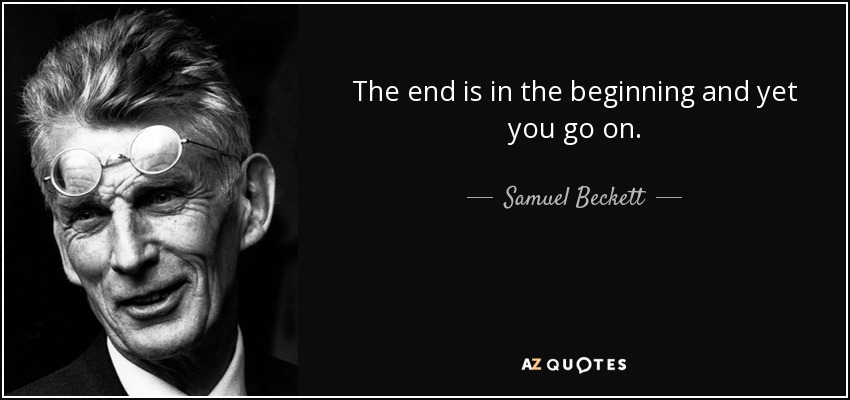
“My way is in the sand, flowing between the shingle and the dune ...hurrying to its beginning, to its end.”
Source:Silence to Silence, a documentary on Beckett
Impassioned, deprived of agency (Petra’s highlight), the old man from Beckett’s novella, “The End,” originally written in French, lets himself be clad and done, on his way out of an unnamed charitable institution, as no more use may be derived from him. Church, hospital, asylum, the place remains uncertain, the man lacks a name, and a string of other unnamed ones, a girl with red braids, an owner, a Turkish/ Greek woman, a boy, a policeman, a man, a priest ... parade the ghostly ride to the end.
“Unreal city, under the fog of a winter down” (T.S.Eliot “The Waste Land”)
The man, well on years, as most of Beckett’s characters are ( “Silence to Silence) walks towards the sought for and inexorable path of his end from the beginning of the narrative (Eva's highlight). The old man, but a shadow, “All I remember is my feet emerging from my shadow, one after the other” (highlighted by Sonsoles ), wears a death man’s suit, and, impervious to the world’s ruthlessness, lives in the small world rather than the big one, as Beckett stated ( “Silence to Silence”), an outcast who wanders through city and countryside in search of a dwelling, a place for self-abandonment.
He feels more identified with the objects that have morphed into his own shape rather than the surrounding human element. A wooden stool bears the shape of his cyst, a bench in the park is indented with his hindside, and the window at the charitable institution has the shape of his eyes. Sleeps in a dung heap, lives in a basement, eager to share the place with a pig, rolls in excrement, brews sores, itches (Sonia’s highlights), pain, physical restlessness keeps him going. Even the crocus he has manured with his own urine has a “wilting stem and a few chlorotic leaves” (page 16).
Despite the dramatic situation of his physical deterioration and isolation, no air of tragedy insufflates the narrative, but just a perfunctory way of facing his destiny. However, some emotional undertones are strewn here and there: a priest offers help, but he does not write his name ( Sonia’s highlight), a man who offers him his abode, and an articulate moment of anger about his son, “that insufferable son of a bitch” (Marian and Geni highlighted this moment):
“One day I caught side of my son. He was striding along with a briefcase under his arm. He took off his hat and bowed and I saw he was as bald as coot. I was almost certain it was he. I turned round to gaze after him. He went bustling along on his duck feet, bowing and scraping and flourishing his hat left and right. The insufferable son of a bitch” (19)
His perambulation not only marks his physical deterioration and stalwart perusal of the end, but it also exposes the cruelty and the disaffection of the many he encounters in his way:
“He was bellowing so loud that snatches of his discourse reached my ears. Union….brothers….Marx….capital...All of a sudden he turned and pointed at me, as at an exhibit. Look at this down and out, he vociferated, a leftover...old, lousy, rotten, ripe for the muckheap” (26) (Nuria and Emma highlighted this passage and commented on it).
An epiphanic moment of social awareness by contrastive output of external perception?
Another contrasting subtlety of the story should not be passed unnoticed as commented on by Cándido and which points to a possible transformative otherness of the old man as a woman. Protean metamorphoses of bodily and situational place:
"They all refused to take me up. In other clothes, with another face, they might have taken me up. I must have changed since my expulsion from the basement...The face notably seemed to have attained its climacteric. The humble, ingenuous smile would no longer come, nor the expression of candid misery, showing the stars and the distaff."
His final dwelling, a mesmerism, or a real tomb?
“I found a boat, upside down, I righted it, chocked it up with stones and pieces of wood, took out the thwarts and made a bed inside… The sea, the sky, the mountains and the island closed in and crushed me a mighty systole ...The memory came faint and cold of the story I might have told, a story in the likeness of my life, I mean without the courage to end or the strength to go on” (27)
Note: The title to this essay is an echo of the last sentence in “Waiting for Godot” which also appears in this story ( Sonia’s highlight)


