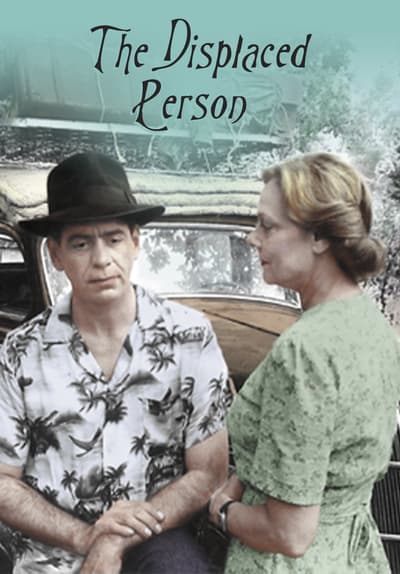
GOOD COUNTRY PEOPLE
Try your knowledge of the events in the short story
with this Jeopardy Quiz
exclusively elaborated for our reading club

The Artificial Nigger by Flannery O’Connor.

Deriding Burlesque ...
The title of this short story refers to statues popular in the Jim Crow-era Southern United States (click here for further information), depicting grotesque minstrelsy characters (thanks Marián Machado for bringing up this reference).
The minstrel show, also called minstrelsy, is an American theatrical form, popular from the early 19th to the early 20th century, that was founded on the comic enactment of racial, stereotypes. The tradition reached its zenith between 1850 and 1870. Although the form gradually disappeared from the professional theatres and became purely a vehicle for amateurs, its influence endured—in vaudeville, radio, and television as well as in the motion-picture and world-music industries of the 20th and 21st centuries. The earliest minstrel shows were staged by white male minstrels (traveling musicians) who, with their faces painted black, caricature the singing and dancing of slaves.Source: https://www.britannica.com/art/minstrel-show
The word “caricature” immediately takes us to Flannery’s world. “The Artificial Nigger” opens up with Mr Head, ready to embark on a trip to show Nelson, his grandson, the ways of the world. Initially portrayed with a questionable flair of superior moral guidance, he is launched center stage within the narrowing focus of the moonlight and, mockingly, compared with the great guides of men, “Dante, or better, Raphael, awakened by a blast of God’s light”(250). We will later find that Mr Head’s name does not live up to the expectations of his assumed moral guidance due to an inherently flawed nature.
The narrator’s use of “as if” implies detachment from an omniscient role and a failure to acutely depict reality. This detachment undermines Mr Nelson’s perfunctory role as a man that “has entered into that calming understanding of life that makes him a suitable guide for the young” (249). His suit lying on a chair has a more noble air than he does. Old age does not pair up with wisdom. Many narrative moments will amalgamate the two characters in indistinct borderlines until an almost chiastic exchange takes place towards the end of the short story. Their ghost-like reflection on the window of the train indicates their unformed and unshaped existence:
"Mr Head looked like an ancient child and
Nelson like a miniature old man." (269)
Before this moment, confrontation ensues as they contest for knowledge about the world, the city, about what a “nigger” looks like – Mr Head’s intent lesson--a concept Nelson fails to understand as the incipient tabula rasa he seems to be, and, therefore, impervious to prejudice.
Both characters constantly appear at junctions, crossways, intersections, in an oneiric landscape in which a train glides phantasmagorically to lead them in a trip of “discovery,” a seemingly rite of passage for Nelson. However, rather than expertise, the trip is intended to function as a deterrent for Nelson’s inquisitive nature, and a lesson he will never forget as Mr Nelson puts it.
They wander in circles, shadows, tunnels, darkness, sewers, the bowels of the earth… They stroll through a black neighbourhood where Nelson feels drawn to “a large coloured woman leaning in a doorway”, a surrogate mother figure? (suggested by Begoña Rodríguez ) for the bereft child, a search for protection? (Xoel González), or even a concupiscent entrance in the ways of the world? (Marián Machado)
After the practical joke that Mr Head plays on Nelson in which he denies his grandson, (Biblical overtones) denial, expiation, guilt and remorse ensue. Nelson is emotionally void after being rejected, and the way in which he is described leads us to draw connections with some crafty fabrication:
“The child was standing about ten feet away, his face bloodless under the gray hat. His eyes were triumphantly cold. There was no light in them, no feeling, no interest. He was merely there, a small figure, waiting.”
Could Nelson be possibly “The Artificial Nigger”? Marcial suggested that the opening of the story had echoes of Nelson being a puppet and Mr Head a puppeteer: the boy sleeps in an obscure part of the room, on a pallet, in foetal position, still as the night and about to be relivened and string-pulled into a journey of non-discovery.
Is there any grace, mercy, expiation for Mr Head? The two characters are drawn together by the recognition of an artificial nigger in a white neighbourhood of iceberg-like houses. The characters vanish in the sunset which still holds traces of the night, get on a train in the suburbs and are dropped in another non - official stop at another junction.
FLANNERY O'CONNOR: AN INTRODUCTION
"A GOOD MAN IS HARD TO FIND"

MEMORABLE OPENINGS
THE SHORT STORY: AN INTRODUCTION

“I don’t know when I died” (Samuel Beckett, “The Calmative”)
“Unfortunately, things did not turn out well …” (D.H. Lawrence, “The Fox”)
“There was no hope for him this time: it was the third stroke” (James Joyce, “The Sisters”)
These words constitute one of those master effect openings that make of the short story an elevated art and craft. The curtain raises and the miniature world of plot twists, viewpoints, framing devices, enticing and playful effects give rise to a narrative form whose defining criterion goes beyond length. Intensity and unity will mark the path.
In Joyce’s “There was no hope for him this time: it was the third stroke,” Kahn points that “a character´s fate is revealed even before ‘he’ has been described.
Andrew Kahn’s “The Short Story. A very Short Introduction” (chapters 1-3 for this section) can be used as a point of departure that will aid to understand the dawning of the short story as a genre. From its first appearance in magazines and newspapers --slicker magazines for quality stories, pulp magazines for other thrills -- hand in hand with the development of the printed press, the Industrial Age, the increase in readership, short story writing became an outlet for amateurish as well as professional writers. These are some of the platitudes that pepper the dawning of the genre.
Whereas the big openings of literature such as Tolstoy’s “All happy families are happy in the same way but an unhappy family is unhappy in its own way” (Anna Karenina) raises a world of expectations that will spin throughout the novel, in short stories, opening lines constitute a first act. Kahn compares Tolstoy’s opening with Joy Williams’ “Hammer”
“Angela had only one child, a daughter who abhorred her” (p.16)
“like Anna Karenina, this start is also about family relations, but concerns one famly and one relationship rather than bourgeois families in the abstract. Yet, as Frank O’Connor notes in The Lonely Voice, every significant literary story has an initial thesis, covert or declared, beyond the development of the plot.”
The short story has been grounds to explore the rural, the national, the small and has shaped later into the perfect terrain to explore those edgy subjects of a globalized world.
Frank O’Connor, V.S.Pritchett, Ray Bradbury, Alice Munro, V.S.Pritchett, Kipling, Katherine Mansfield, Tolstoy, Edgar Allan Poe, James Joyce, a chapter entirely devoted to Chekhov and its heirs, take over as the stronghold of short story writing among many others...which we will sinfully forget in this inaugural season post. One particular statement should be cited to capture the spirit of short story writing, and that is, the allusion to Katherine Mansfield that “dates back as early as 1923,” Andrew Kahn says, “when a critic of The Observer proclaimed that the short story is bound to begin with her name,”
“whose (Katherine Mansfield's) ability to crystallize ‘ in a cry, a phrase, a gesture, a moment of feeling or vision’ captures what was best about the genre that also set it apart from the novel.” (page 12)