20 Jan 2025

"The Catcher in the Rye" by J.D.Salinger

 “Growing Pains” in J.D.Salinger’s “The Catcher in the Rye”
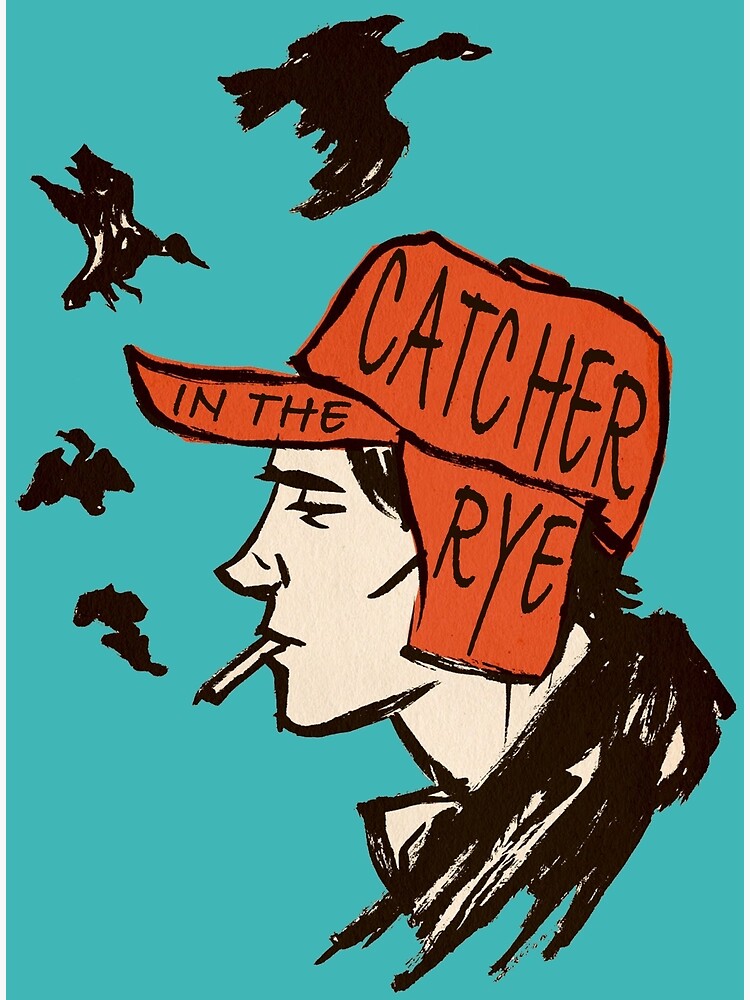
Póster for Sale con la obra «Holden Caulfield, Catcher In The Rye» de  mindesigner | Redbubble

Source: here

Holden Caulfield ushers us into the story of his life: “If you want to hear about it” no problem”, but warns that he will not follow the line of that “David Copperfield’s kind of crap.”

Having a look at the first chapter of Charles Dickens’s “David Copperfield,” a first-person narrator details the precise hour of his birth, day, and circumstances: Friday, midnight, dispossessed, and with a caul that was bid for. Begoña brought the interesting meaning of “caul” a membrane that covers the newborn’s face and body, a case occurring once in 80, 000 births. A symbol for protection? The sage ladies have prophesied David’s unlucky destiny as well as his gift to see ghosts and spirits, a flair all “unlucky children” have according to David. 

Caulfield’s narrative does not deviate from David Copperfield’s. His name evokes the “caul” / David Copperfield’s protecting membrane. He chases the ghost of his brother Allie and the ghost of his bygone childhood to face the “pains of growing.” And we are certainly given “oodles” (to follow the language game) of factual information about him as well: he attends expensive schools; has three siblings, Phoebe, Allie who died, and D.B., a writer he says has prostituted himself working for Hollywood.  He comes from a well off family and his granny has lost it giving him money for his birthday more than once a year. His father works as a lawyer, and his mum seems to suffer from a nervous condition.  He wears a red hunting hat, and has been "axed" from some phony schools.

He initiates his ritual into adulthood on a Friday / weekend in a Dantesque (metaphor owned to Mónica) and Joycean perambulation through the streets of New York after being “axed” (expelled from) his phony school “Pencey,” to finally reach his parents’ home, his return to his Itaca. A teenage sulking and nonconformist tone pervades the whole novel passing harsh and vitriolic criticism on the world he evidences. Traumatic experiences, beatings, unrequited love, unfairness, physical and moral abuse, and social double standards are some of the hurdles he must overcome. He unquestioningly states that the only thing he would like is to catch the children in the rye, to save them from falling into the precipice as Robert Burns poem recounts, yet, Burns's poem has sexual undertones that infer the danger might go deeper.

Where do the ducks go when the lake freezes? He questions. Sonia highlighted very interestingly that Holden appears towards the end of the novel, sitting by the empty frozen lake, on the brink of pneumonia.  This idea that frantically chases Caulden reminisces Yeats’ “The Wild Swans at Coole” (click here to read the poem) as a symbol of what is gone, and changed. Unlike the avian flock, time freezes and perpetuates in museums within their glass cases: the Indian natives are crystallized in a moment, but Holden thinks we are never the same person twice.

The relentless Heraclitean loop of time spares no child, a truth reflected in the narrative through Phoebe, who embodies the emblems of Caulfield—a hunting-red hat perched on her head and a suitcase in hand—when they agree to meet at the museum. Caulfield muses that time seems to freeze in museums, yet the observer is never the same when gazing upon the exhibits, and growing pains.

“I took my old hunting hat out of my pocket while I walked, and put it on. I knew I wouldn't meet anybody that knew me, and it was pretty damp out. I kept walking and walking, and I kept thinking about old Phoebe going to that museum on Saturdays the way I used to. I thought about how she'd see the same stuff I used to see, and how she'd be different every time she saw it. It didn't exactly depress me to think about it, but it didn't make me feel gay as hell, either. Certain things should stay the way they are. You ought to be able to stick them in one of those big glass cases and just leave them alone. I know that's impossible, but it's too bad anyway. Anyway, I kept thinking about all that while I walked. “ (Chapter 16)


1 Dec 2024

The Sieve and the Sand in "Fahrenheit 451" by Ray Bradbury


Fahrenheit 451 The Sieve and the Sand Analogy by ClassicsandCoffee


No Fireplace in the Empty Hearth but Caustic Fire


The section opens up with a saddened cadence of Montag’s reading to his wife from one of the books he has salvaged from the caustic fire. The setting is an empty house with barren walls that mirrors the emptiness of their lives. “The family” as Mildred calls her TV shows has been shut down.” The incendiary pace of the first section has suffused after the dramatic self- immolation of an elderly lady who would rather perish than forsake her literary treasures. No hearth is found here: the words Montag reads bounce off in the void of Millie’s soul.

Clarisse, the perceptive young woman, seemed to mirror a younger, more introspective version of Montag in the earlier section. In this one, Faber—the guardian of books—represents a potential vision of an older, wiser Montag. Driven by a frantic search for meaning, Montag embarks on a maddening journey of self-discovery as he strives to save the written word from oblivion.

“Memory like a Sieve”

Montag understands that by memorizing the books he can be the bearer of a holy grail and thus, contribute to save them. Indeed, before handing Beatty his treasured possession of “Ecclesiastes,” he tries to memorize it, but the words slide through his mind, distracted by the clatter of the tube and the disquieting jingles of a toothpaste commercial. Metallic, numbed, nulled … his mind is arrested by the devouring expediency of modern life: 

“Guy's modern world counts on this inability to concentrate. This world he lives in without books has encouraged people to live for the immediate moment; it's a world of sound bites and expediency. By filling every place with mindless sound such as the advertisement jingle, people can't concentrate and do any serious thinking. If people can't think, they are much more easily controlled. This is just where society, and the government in the book, want people. By banning books, people's minds have been turned into sieves unable to hold thought.”  Source; here

Logos: the first Word

"In the beginning was the Word, and the Word was with God, and the Word was God." (John 1:1). “Word” translated from the Greek “Logos”

Logos / word embodies an unfleshed god that later turned into a human. Following the thread of this metaphor, it is noticeable that the book Montag is trying to memorize is the Bible, the word “par excellence.” Religious metaphors sprinkle “Fahrenheit 451.” Marcial brought to our attention the equation between Montag and St Paul, or the river that will later appear in section three, “Burning Bright,” with the river Jordan. Equally, the Harvard inmates he finds in the river jokingly acknowledge themselves as the Apostles (comments indebted to Marcial). 

Montag’s recitation of Matthew Arnold’s Dover Beach to Mildred’s friends juxtaposes the dark, oppressive world surrounding him—marked by the relentless burning of books and the authoritarian surveillance of citizens—with a world of profound emotion, one that stirs and wrenches the hearts of those who struggle to bear the weight of genuine feeling.


                                                   Ah, love, let us be true

To one another! for the world, which seems

To lie before us like a land of dreams,

So various, so beautiful, so new,

Hath really neither joy, nor love, nor light,

Nor certitude, nor peace, nor help for pain;

And we are here as on a darkling plain

Swept with confused alarms of struggle and flight,

Where ignorant armies clash by night.

Beatty, the fire brigade captain, humiliates Montag in a verbal duel laden with literary references, leaving Montag unable to respond. Reduced to silence, he succumbs to Beatty's rhetorical dominance, embodying the numbness that defines him throughout the first and second sections of the novel. It is only in the third section, during his journey down the river, that this numbness begins to dissolve in a symbolic act of rebirth (drawing on Marcial’s imagery of the river as a metaphor for renewal). Beatty’s pointed remark:“Who are a little wise, the best fools be”  can be traced back to John Donne’s poem The Triple Fool (click on the title to read the full poem):


I am two fools, I know, 

For loving, and for saying so 

In whining poetry; 

But where's that wiseman, that would not be I, 

If she would not deny? 

Then as th' earth's inward narrow crooked lanes 

Do purge sea water's fretful salt away,

I thought, if I could draw my pains 

Through rhyme's vexation, I should them allay. 

Grief brought to numbers cannot be so fierce, 

For he tames it, that fetters it in verse. 

It is specially interesting to notice the two last lines where the power of the written word seems to be highlighted, for Donne, the poem will be a memento of his pain because it will be “fettered” in words but it will also be be liberating because as he puts his thoughts in words he will be released of their pain. Montag will be the wise fool because he did what he had to do by acknowledging that the books are more than stitched pieces of paper, they bear the immanence of the thoughts and knowledge of the writers that wrote them. 

24 Nov 2024

"To the Love of Books"


Love letters to Books de Ana María Sánchez Mosquera

16 Nov 2024

"Fahrenheit 451" by Ray Bradbury


How to live forever: Brushstrokes on the author

Source here

The author of “How to live forever” in Dandelion Wine, is now approached in what he deems his only sci-fi novel: "Fahrenheit 451.  Check this interview here where most of the thoughts below mentioned  have been extracted from:

Bradbury on Fahrenheit 451

Cándido proposed the reading of Fahrenheit 451 to the Reading Club and truly, triggered by his profound admiring of Bradbury which I / we absolutely back, we incorporated the novel into our program. A book on books being burned, censored, and banned is absolutely a must for book lovers, as Cándido stated. There is a long history of orchestrated book burning:

The Roman Empire burned up countless books over the course of its long reign. The first emperor, Augustus — objecting to books of “prophesies and destinies” — ordered more than 2,000 books to be reduced to smoke and ashes, according to “Book Burning” by Haig A. Bosmajian. One of the greatest losses of literature was at the Library of Alexandria, established under Alexander the Great in northern Egypt around 331 BC. The library was burned down at least three times over hundreds of years and is now permanently erased. At one point, the Library of Alexandria held over half a million documents from multiple nations, including present-day Syria, Greece, Persia, Egypt and India....Nazi Germany’s incineration of 25,000 “un-German” works on May 10, 1933, is perhaps the most infamous book burning event because photos and videos of the event can still be seen today. Source here

“Fahrenheit 451” unspins the dystopia of the world without books, where books are forbidden, burned, and may compromise the stakeholders.

Bradbury mentions in this interview how passion-oriented he is and how committed he had been to writing as a naturally driven force inside him: “I never worked a day in my life,” he adds  that he followed a passion rather than a job.  Aside from any intellectualization that might have broken the pace of his throbbing heart on a throbbing machine, Bradbury confesses himself as a self-taught man who has lived in libraries all his life. Libraries and books being burnt as well as his fantasies and admiration for the fire department where his uncle worked might have been the seeding bed for building a story arch. “Fahrenheit 451” started in the cellar of UCLA where typewriting machines could be rented for a few cents an hour.  With a recently born baby and a small house, Ray Bradbury took a bag of dimes and embarked on the writing of an earlier version of “Fahrenheit,” which was completed in 9 days in 25, 000 words. “The Pedestrian” had him started in the writing among many other tales, or stories from his other books. In "The Pedestrian," he recounts an unfortunate encounter with a policeman who reprimanded him and his friend by mere walking and talking on the streets. This might lead to establishing connections with Montag's unexpected encounter with Clarisse at night time.

The title was brewed through inquiring research about the temperature at which paper burns. He contacted the Chemistry department to know but no certainty was given until he realized he could phone the fire department, it was then when the title was rendered: Paper burns at 451 Fahrenheit, and he repeated Fahrenheit 451.


"Mrs. Stern Wanders the State Prussian Library" by Jenny Lyn Bader

  MRS STERNS WANDERS THE PRUSSIAN LIBRARY de Ana María Sánchez Mosquera