4 Feb 2023

BOOK RECOMMENDATION


Retrieving women's voices


“Save me the Waltz” by Zelda Fitzgerald

Reviewed by Begoña Rodríguez Varela


"Save me the Waltz"...beautiful title, isn´t it?. It conjures up pictures of glamorous high class couples dancing in spacious saloons with luminous chandeliers hanging from the ceiling. However, during the Roaring Twenties , it was Jazz music not classical music that was fashionable and was listened to in clubs. The novel is not concerned with parties although there are some of them in the novel and Alabama, the protagonist, appears at the end emptying ashtrays after the last party is over. Indeed, It all comes to an end. All ashes. Her father´s death, her broken dream to become a ballerina and her love for her husband are at the end of a long journey . Only the vivid image of Nature can be cathartic ...or not.

Alabama’s hard struggle to have her own identity ( there are mirrors everywhere) is also Zelda‘s struggle to find her own voice and style away from the shadow of her husband and escape patriarchal and patronizing behaviours.

That fight can be seen in the language. It ranges from the baroque and flamboyant language of the beginning of the novel to the more simple and plain style at the end , when she gets rid of the superflous in her life. In addition to that, the luxuriant colourful depictions of lanscape ( above all The South)the surrealist, oneiric images and symbols show that her voice was unique, although her husband, Scott, derided her talents.

In the same way , Alabama´s husband, David, is clearly defined in two sentences "David, David, David, Knight, Knight , Knight and Miss Alabama Nothing". Narcissistic. Equally, she gives her beloved daughter some advice. "Never be a back-seat driver". Controlling

Alabama ( the author’s alter ego ) is well aware of the reasons of why theirs was a broken marriage. She must have felt alone many times (Both). Part bildungsroman, part autobiographical. The novel is insightful and deeply moving. ...Only a bit rambling. I liked it a lot.


29 Jan 2023

"The Swimmer" by John Cheever

 The Swimmer (1964)

by

John Cheever (1912-1982) 

Click here for source


John Cheever, known as "The Chekhov of the Suburbs for his ability to capture the drama and sadness of the lives of his characters by revealing the undercurrents of apparently insignificant events” (source here) braids, in his well-known short story, “The Swimmer,” first published in “The New Yorker” in 1964, the quintessential epic of self-quest with harsh criticism of the American bourgeois way of living.


Neddy is heading back home, after a party, at the Westerhazy’s, through swimming all the swimming pools of his neighbourhood.


    Neddy Merrill feels himself to be an explorer, a pilgrim, a legendary figure, as research scholar Nasrullah Mambrol explains in “Analysis of John Cheever’s The Swimmer,” and he will embark in a “diurnal, seasonal and biographical journey.” Neddy will call the new streak of water “Lucinda,” like his wife, a territory to be conquered in the fashion of explorers, yet the battle is lost from the very beginning. Rather than swimming home, he flees from the embodiment of his home, his wife and family. He abandons Lucinda / Penelope at the Wasterhazy’s and only swims to a material idea of home. Neddy transitions from a blissful, energetic, full- of -vim state in day time, bracing and immersing himself in clear-water swimming pools, to aging, decline, social descent as midsummer touches an end, swimming through darker and murkier waters.


    The short story opens up with one of those “midsummer Sundays,” in which parishioners, tennis players, wildlife watchers, even the priest are all pervaded by the haziness of a hangover. Alcohol will be indeed omnipresent: Neddy stops at each of the swimming pools to have a drink. The word “stupefaction” appears frequently in the short story. This haziness or stupefaction that alcohol brings about runs paralell with Neddy´s inability to remember. Indeed, Neddy departs from the Westerhazy’s swimming-pool, whose name is illustrative of omens to be fulfilled, “West,” associated with “death” as the sun dies in the “West” and “hazy” (blurriness), cloudiness of thoughts, not being able to remember.


    The narrative voice deflates Ned’s prospects of heroic deeds. “He was far from young,” the narrator’s voice points, and “he might have been compared to a summer’s day,” but “particularly the last hours of one.” Shakespeare’s sonnet, echoed in these words,  constitutes a reverse of what Neddy represents. Unlike in Shakespeare’s Sonnet 18 (click on the number if you want to listen to it), where the beloved competes, transcends, and overcomes the beauty of a summer day, Neddy does not outdo the summer day with his infatuated airs of being young, but, contrary to that, the passage of time and the passing of the season will leave furrows in his body’s field, echoing another sonnet by Shakespeare (Click here if you want to listen to it: Sonnet 2): “When forty winters shall beseige thy brow and dig deep trenches in thy beauty’s field.” He will be driven into physical deterioration through exhaustion and disillusionment.


    Mambrol describes the first swimming pool which Neddy traverses as a simil of his being born, of his early stages of life, those green waters in which he “crawls” echo the maternal womb and the amniotic liquid. Everything is blissful and eden-like at this stage “embraced and sustained by the light-green water seemed not as much as pleasure as the resumption of his natural condition.” Later, there is also an allusion to an apple-tree blossoming (reminiscent of Eden).


    As he traverses hedges, even a highway, and immerses himself in his neighbours pools, strewn pieces of his life come afloat: bankruptcy, marital issues, a mistress, debts, abandoned friends ... His pilgrimage equally showcases the flaws and superfluousness of American bourgeoise society. He starts to feel feeble and tired with the swimming, yet he struggles till the end. Dried pools interrupt his chain of swimming, abandoned houses, houses for sale… At the public swimming-pool, there are rules and regulations, but he still fights his sense of belonging to a certain status by being deprecatory of a crowd that jostles him (comment indebted to Marián). He has no identification disc, and the guardians of the public pool chase him off. This literal lack of identity dovetails with his efforts to remember. When he finally reaches his home, he seems to be an old man, who can barely walk on his legs, and he finds his house empty and dark with nobody inside, yet, he is still resistant to come to terms with his social descent and loneliness by calling out the cook or the maid (comment indebted to Cándido).


The Swimmer / TV ad 1992: “Mad about the Boy” by Dinah Washington / (Courtesy of Cándido)


The Swimmer (1968). with Burt Lancaster and Janet Landgard, directed by Frank Perry


22 Jan 2023

"The Short Happy Life of Francis Macomber" by Ernest Hemingway

"The Short Happy Life of Francis Macomber"

by Ernest Hemingway 


Source: here


14 Jan 2023

"The Snows of Kilimanjaro " by Ernest Hemingway


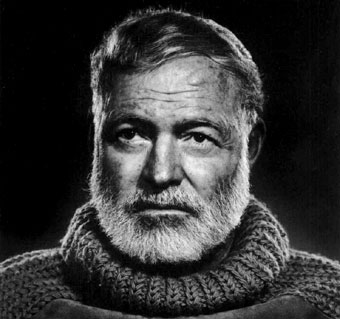
Ernest Hemingway (1989 Illinois- 1962 Idaho)


Source for photo


 “The Snows of Kilimanjaro”

Martin Amis in “Style as Morality” describes Faulkner’s writing shaped by his Southern Christian upbring and defines his prose as “purple, liturgical, biblical, convoluted, ornate, whereas Hemingway’s style is concise, fleeting, laconic, pithy…, capturing the flicker of the moment…

Though both are almost contemporary in time, their literary, stylistic worlds go different ways. With Hemingway, we move onto the so called “Lost Generation” a term coined by Gertrude Stein,” heard it used by a garage owner referring to the post-World War I generation as a “génération perdue” and later institutionalized by Hemingway in his novel “The Sun Also Rises” (1928), where he captures the attitudes of a hard-drinking, fast-living set of desillusioned young explatriates in postwar Paris” (source here)

Decadence, masculinity, impotence, desillusionment, reinterpretation of the past as an idealized glorious moment constituted some of the converging topics of this group of writers among which we can find Ezra Pound, John dos Passos, T.S.Eliot, Gertrude Stein, Scott Fitzgerald and Hemingway among others.

Hemingway’s conciseness and unornate prose is part of his journalistic style as well as of his iceberg theory in which worlds are suggested rather than described, withholding information from the readers, engaging them in the reading and the building of the story. He might be talking about death without mentioning the word, or about “ making love” as those “ all other things were unreal” in “A Farewell to Arms” (source)

“The Snows of Kilimanjaro” (1936) starts with an epigraph / epitaph, a factual account of Kilimanjaro: height, name, setting ... However, all these details blend with a more mystical meaning of the mountain as the lying place for the “dried and frozen carcass of a leopard," “no one has explained what the leopard was seeking at that altitude”.

This static portrayal of the mountain and the carcass of the leopard as a symbol of some possible immanence or immortality, as suggested ,contrast with the fugitive moment of the narrative to be faced: we are running out of time, there is a man dying from gangrene.

The short story is divided in six sections and structured around flashbacks of interior monologue (stream of consciousness) and dappled ruthless dialogue between Harry, and his partner, Helen, both nameless at first. Distance and closeness are suggested: “distance” as we see the tip of the iceberg, closeness because we are part of their conversational exchange in an important moment of their lives. We only know that the man is Harry through Helen’s remonstrances towards him as well as her support and patience. Harry’s spite towards Helen comes from the depths of his heart, his impotence, and frustration as partner, man and writer.

Numbness is the word that captures the spirit of the opening lines, you know that it starts because it is painless, the man says. Numbness of feelings, numbness of the body.

Next, we see vultures “obscenely” soaring the sky, shadows that will later blend with the presence of the shadow of death. The vultures, buzzards, carrion-feeders are redolent of putrefaction. They scavenge the plains in search of putrefying bodies and all the more meaningful as Harry becomes prey to them.

Harry’s gangrene is a result of his self-abandonment; this self-neglect  can be transferred to  his role as a writer.  He constantly moans about his inability as a writer, and his lack of inspiration which might as well be autobiographical, in the flashbacks in italics. Contradictorily, he is actually writing about all that has remained untold.

In his reverie, the snow, as a symbol, has manifold meanings, many times associated with preservation of corpses, drinking, isolation, cruelty, “trampled snow,” “bloody snow,” war, gambling … other moments this cruelty subsides into a peaceful landscape of blanketed white and comradeship.

Finally, there is an image of Harry in a rescue plane above the mountains where he peacefully envisions the summit of Kilimanjaro. The animals he sees from the heights are not predatory ones anymore. The landscape of ice and frost has thawed through fire, wind, and water. It is only the clear isolated crowning snow of the Kilimanjaro mountain which he can peacefully see. Reading this passage, one might have thought of a happy ending in which trouble has been resumed, yet, a twist of the narrative takes us back to the plains, to the tent where the gangrened leg is dangling from a side and we hear the hyena “making the same strange noise that had awakened her”

Some criticism of the short story talks about redemption of Harry through some acknowledged acts of self-expiation, and his vision of Kilimanjaro as a heavenly ascent to height which epitomizes his immortality as the immortality of the carcass of the leopard through his own process of writing.


What do you think?


1 Jan 2023

"At First there was Nothing..."

 "AT FIRST THERE WAS NOTHING ..."

CREATIVE WRITING

PROMPTED BY FAULKNER'S "The Old People"

Source for image click here


"The Life of Violet" by V. Woolf

  MAGIC GARDEN: A REVIEW by Belén Tizón AI generated picture The three stories collected in The Life of Violet provide, to an extent, the b...