4 Dec 2021

27 Nov 2021
KIPPS AND BELSEY (Part 1 "On Beauty" by Zadie Smith)
KIPPS AND BELSEY
(On Beauty by Zadie Smith)
(Session 25th November)
Referred to by Monty Kipps

Rembrandt’s “Self-Portrait.” Munich (1629)
Referred to by Howard Belsey

Upon a first approach to Zadie Smith, we have come across what James Wood denominates “hysterical realism” in his article, ”Human, all too Inhuman” (The New Republic, 2000 ), a pressing , emergent and “harding” genre in the narrative of current novels. Zadie Smith is mentioned among the many names to whom this “hysterical realism” might be attributed . As we understand, hysterical realism dwells on sometimes impossible interconnected and overdetailed characterization in a search for a human and “realistic” approach to character depiction and narrative events, but, which, contrariwise to its pursued effects, results in impossible connections, far-fetched liaisons and shallow waters.
Ready for this Dickensian “puppetry” that James Wood mentions and, with minds formed to it, we break through the world of the Belseys and Kippses in Zadie Smith’s novel On Beauty, awarded the Orange prize in 2006. Yet, the chalant warning flounders in the careful “scaffolding” (a word that Zadie Smith uses herself to explain her process of writing) of the two families, Kipps and Belseys; two places, London and the fictional University town of Wellington near Boston; two political and spiritual mindsets (conservative and liberal, Christian and atheist) that will conform the tapestry of the novel.
The first part of the book dwells more on the Belseys than on the Kippses, indeed, there is no direct access to the Kippses but, through the perspective of the Belseys. Jerome, the sensitive Belsey’s son, opens up a narrative on “beauty” with unpoetic and unanswered emails from the Kippses household addressed to his father to announce his wedding with Victoria, the Kippses’ daughter. Howard embarks on a swift journey to London to stop the marriage, questions of religion at stake, but, a last email heaves through the “electronic machine waves” and only Kiki, the matriarch of the Belsey family, knows that the prospective marriage has already been written off.
Vitriolic criticism sheathed in humor key preys on the phoney world of intellectuals and academics. Liberal and atheist Howard, originally from England, is in dispute with the conservative and Christian Monty, originally from Trinidad. They are both Art History professors, both working on Rembrandt. Whereas Howard’s book on Rembrandt remains unbound, strewn and unfinished, his colleague’s has been published. Howard has shamed himself in front of the academic community by confusing Rembrandt’s “Self-Portrait” (Munich) with “Self-Portrait with Lace Collar” (The Hague) which Monty mentioned in his research.
Academic elitism dovetails with racial and gender issues: Carle, a rap poet, who attends a classical music recital (Mozart’s “Requiem”), wanders as an outcast in the circle of the intellectual elite. Kiki, with Afro-American origins, is also an outcast in the intellectual world of Howard, but, constitutes the first glimpse of beauty and authenticity in the novel. The Belsey’s home is really Kiki’s inherited home, nothing “nouveu riche” about it, and, which, in spite of its shabbiness, constitutes a bastion of her sturdiness. Pictures of Kiki’s ancestors through the staircase constitute a counterpoint to Howards’ ridicule Bermuda pictures, or his baseball cap photograph pointing towards Emily Dickinson’s house. Infidelity also lashes out within the cultural constructs of this world.
Interesting intertextual references to search for in this first part of the novel: John Cheever’s short story “The Swimmer,” (see story in The New Yorker, click on title) the importance of Mozart’s “Requiem”, Rembrandt’s “Self-Portrait” (Munich) and Rembrandt’s “Self-Portrait with Lace Collar” (The Hague).
20 Nov 2021
On "The Lazy River" by Zadie Smith
Session 18th November

Some Keywords: Metaphor (μεταφορά), Short form, Circular Flow, Heraclitus, Social Media, Migration, Brexit.
Zadie Smith's “The Lazy River” was first published in The New Yorker , December 2017. One reads the title and does not expect the despair and hopelessness that lies ahead. Incantations of idleness and a Huck Finn journey acrosss the Mississippi, on long Sunday evenings, crosses the mind. Instead, hazy and disquieting borderlines spring as the eye wanders through the opening background blurry illustration by Geoff McFetridge which depicts a faceless lady adrift on a “buoyant” floating device.
More confusion lies ahead with the genre: an explanative metaliterary approach imbibes the reader inside the word “metaphor” and thrushes us into the narrative. “We” become part of the journey that leads nowhere. We find ourselves emmeshed in a circular journey, on an unnamed river, inside a metaphor that gives the impression of flow but leads us to the the starting point. It should not pass unnoticed that the word “metaphor” comes from the Greek μεταφορά (meta-behind, along / ferein: carry), which means “transfer,”” transference from,” “journey from one word to the other” which brings us back to the original.
We wonder whether this short form shapes into fantasy, essay or article. Clichés of British holidaymakers in Southern Spain twist into further depths, at least,“three feet depth.” The narrative voice wanders around the empty rituals they perform: lounging around the lazy river, letting themselves go with the flow; some carry buoyant floating devices, under the same relentless sun, forever, never advancing: others resist the ”ouroboros” thrashing a stroke, but finally yielding to the heraclitean curdled flow.
These holidaymakers do not venture the vast ocean, nor the Moorish ruins, nor the arid mountains, “nor infinite horizons.” They do not venture into unknown territory. The fascinating literary journeys are replaced by sudokus, they gobble at the buffet, but, this is a non-judgemental zone, the narrative voice claims. Yet, there is stealthy shame that arises in between the lines. Shame is a concept that Zadie Smith brings forward in this interview.
Go ahead and comment on any of the issues above that arose in our last session, and, to which you contributed,as usual, with sharp insights and wonderful readings.
All the world’s a stage,
And all the men and women merely players;
They have their exits and their entrances;
And one man in his time plays many parts,
(Shakespeare, “As you Like it”)
6 Nov 2021
ABHILASH TALKIES and small things
Abhilash Talkies and small things
(Chapter 5 The God of Small Things)
Session 4th November
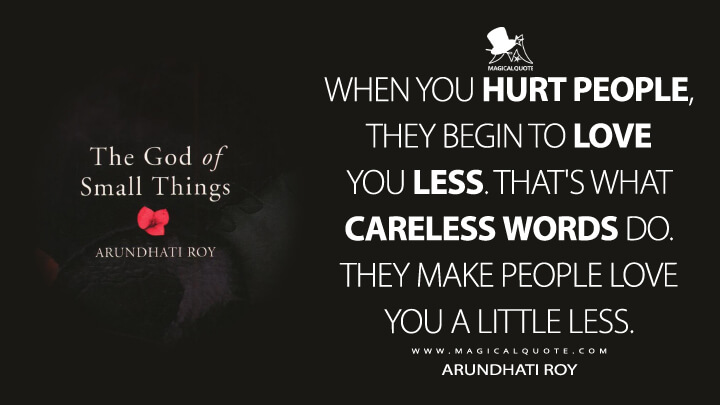
Keywords: Loss of Innocence, trauma, manhood, rites of passage, Lemondrink Orangedrink man. “Rub-a -dub -dub three women in a tub”
“Abhilash Talkies advertised itself as the first cinema hall in Kerala with a 70mm CinemaScope screen. To drive home the point, its façade had been designed as a cement replica of a curved CinemaScope screen. On top (cement writing, neon lighting) it said Abhilash Talkies in English and Malayalam.”
After a tug-of-war in the tailfinned Plymouth, Ammu, Baby Kochama, Estha and Rahel are ready to overcome initial dissension as they cross the foyer of the Abhilash Talkies to indulge in the film “The Sound of Music.” It is ten to two, the time that freezes in the narrative in Rahel's toy wristwatch. “Big things lurk inside” (a leit motiv in the novel) and await them .
THE SMALL THINGS: the red formica door, the slippery oily floor, the dirty marble floor, “the meat smelling blood money” the butcher gave Kochu Maria and that Estha remembers, the rusty forgotten cans of possible "Pickles and Paradise" preserves in the urinary seed a landscape of sheer desolation and ominous trauma wrapped up in nursery rhymes and the sound of music.
The hall heralds division and impending tragedy. The toilets establish the divide between “HIS” and “HERS”: Ammu, Baby Kochama, Rahel on the one hand, and , Estha, on the other. Estha braves the toilets alone, his first act as a little grown man: “Estha alone in his beige and pointy shoes.”
The three women traverse the “HERS” red formica door:
“Rub-a-dub-dub (Rahel thought), Three women in a tub, Tarry awhile said Slow…”
““Rub-a-dub-dub”
is a traditional nursery rhyme that dates back to late 18th
century England , “ the word “maid” being redolent of
virginity. “Later research, according to The Oxford Dictionary of
Nursery Rhymes (1951) suggests that the lyrics are illustrating a
scene of three reputable men watching on the sly a less decent
moment” (see source for this quote below). The three maids were
later replaced by men (ibidem), and Rahel replaces them by women. The possible meanings and connections of this suggestive finding I leave to you (Keywords: gender issues, the act of peeping...)
https://allnurseryrhymes.com/rub-a-dub-dub/
Estha singing in a nun's voice, Estha alone, Estha lost in a nursery rhyme tub to be ogled and molested.
Disrespectful actions are ahead. Estha cannot hold himself from singing in the theatre. He is reprimanded and forced to go out. In the hall, fatal destiny looms over him in the shape of a sulky peeved bear-like man. The Orangedrink, Lemondrink man cajoles Estha into yielding to his dishonest petition. Brutal awakening freezes in time.
Other interesting discussions proffered in this session were: Velutha as the iridiscent beautiful God of small things, “Locusts Stand I,”pervading alarum that Ammu repeats as a mantra, miscegenation, other Fairy Tale comparisons of episode 5, “Little Red Riding Hood,” the language rift (Malayalam and English) … I beckon all participants of last session to develop and make visible through your comments these or other sharp insights you contributed with in the last session.
Subscribe to:
Posts (Atom)
Mr Reginald Peacock's Day by Katherine Mansfield (2)
THE IMPORTANCE OF BEING CALLED MR REGINALD PEACOCK by Belén Tizón Source for photo here Katherine Mansfield does not select her main chara...

-
“Duplicity versus duality” in Margaret Atwood's Alias Grace by Begoña Rodríguez Susanna and the Elders by Artemisia Gentileschi “I felt...
-
“ The Bear,” a review by Begoña Rodríguez Varela “ Into the wind” By Marion Rose (Pic chosen by Begoña Rodríguez Varela) . Click here f...
-
“ HAMNET: Transfiguration of Life into Sublime Art” by Begoña Rodríguez Varela “ Hamlet and the spectre” By Eugène Delacroix : click ...


