7 Dec 2023

Week 4: "The Turn of the Screw"


Last entry on Henry James`"The Turn of the Screw"


Reviewed by Cándido Pintos Andrés

and Marián Machado Panete


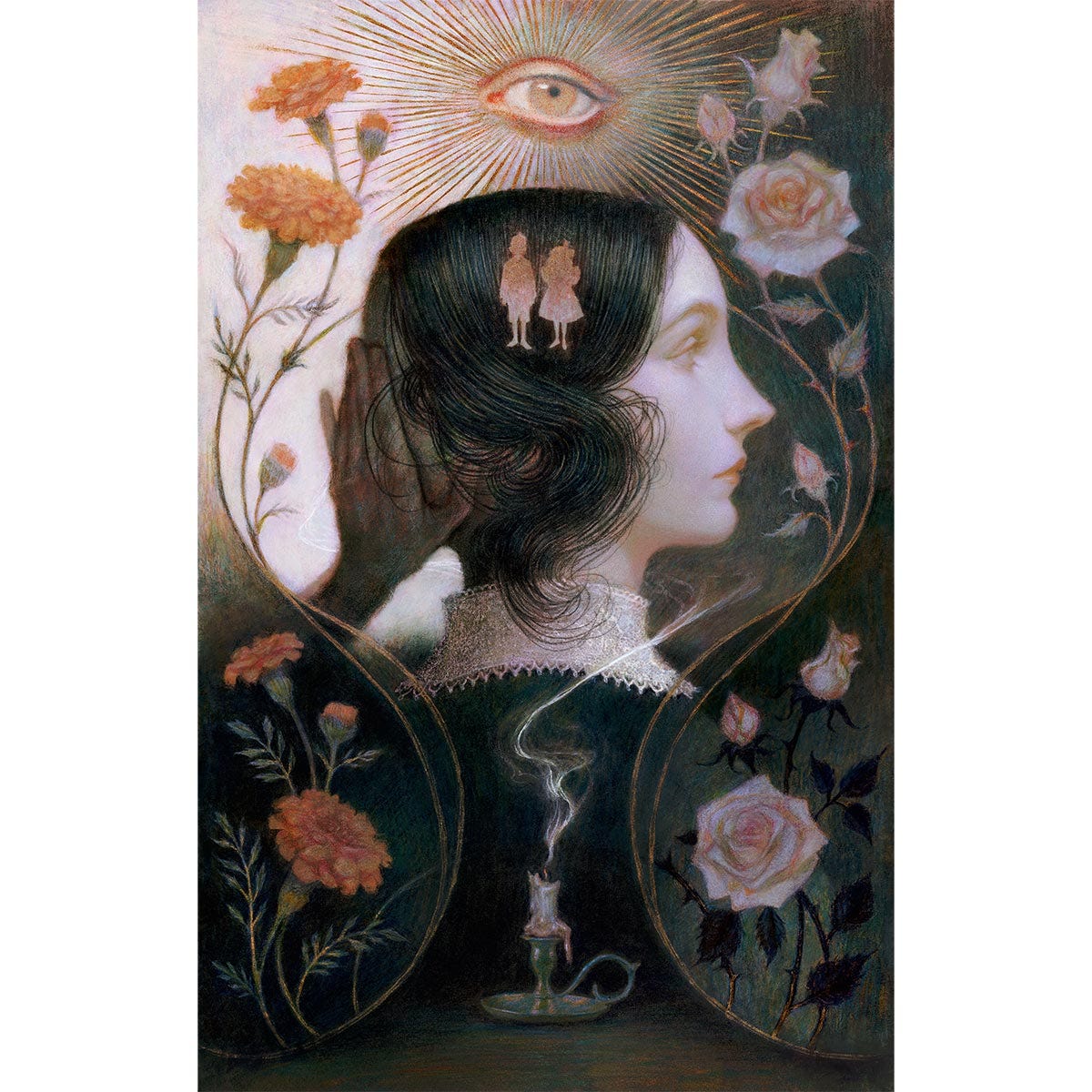
Source for picture


 “The Turn of the Screw”

reviewed by Cándido Pintos Andrés

After 23 chapters of intrigue , mistery and cliffhanger endings, I faced the last one with many questions and just a few pages left to find the answers. After some minutes of reading, I felt  really disappointed because there was no clear explanation for what I was looking for. Are you kidding me Henry ? After all your periphrasis and verbosity and long and intricated phrases is THIS the end? Maybe you want me to feel as lost as the governess or maybe you are The Master of Ambiguity. Perhaps you want me to think of ghosts and sex and corruption and lies at the same time. Maybe you did not finish the tale because you did not want us to gather around the fire with Douglas to find the truth. Or maybe I am losing my mind and that's exactly what you want.


  "The Turn of the Screw"

Reviewed by Marián Machado Panete


If building suspense involves withholding information and raising questions that arouses everyone’s curiosity, we are in front of one of the best examples. This psychological book grips the reader without explicit physical dangers; however the successive chain of events trigger a sense of dread all along the novella. The very end comes as a complete surprise.

Before nowadays serial “cliffhangers” and even Bluma Zeigarnik’s study on memory, in which she compared memory in relation to interrupted and completed tasks, he was able to hold the audience in thrall. Ambiguity, unfinished dialogues and lavish supply of vocabulary arranged in long sentences paved the way for this work of art. No surprise the book has been adapted several times in a variety of media: play, opera, films and a miniseries.

I highly recommend listening to the story. The sound of the words and the rhythm of the language amplifies the suspense.


26 Nov 2023

Week 3: "The Turn of the Screw" by Henry James


Reviews by Belén Tizón Méndez

and Begoña Rodriguez Varela


Chapters 13-18: The Turn of the

 Screw by Henry James reviewed by Belén Tizón Méndez


Source for picture: here

The recurrent topics of this novel are present in these chapters. The governess’ fears for the children are a constant, and, in her attempts to prevent them from being corrupted, she overprotects them. This excessive protection turns her into a manipulative being;she instances the children to write letters to their uncle but does not allow them to send those letters under the pretence of it just being an educational task. She persistently advocates her role as Flora’s and Miles’s nurturer par excellence.

Hallucination and secrecy are also a theme in these pages. The governess finds Mrs Jessel usurping her desk and mistrusts her intentions. The desk is a symbol of power, control exerted by the governess and, Miss Jessel, for some strange reason, challenges this control by occupying it. Suspicion looms. Neither Flora nor Mrs Grose care about the governess’s absence.

The governess keeps showing her insecurity, as a stereotype of a woman of the time, in this drifting vessel commanded by obscure characters.


Towards denôument....

 A review of Henry James' The Turn of the Screw

by Begoña Rodríguez Varela


From the beginning, Douglas’ guests and we, readers alike become jurors of a story written by an unnamed (curious) governess and have to decide whether it is an eerie ghost story or a character study. Clearly, Henry James was a master of this ambiguity. Indeed, openness and ambiguity go hand in hand in this novella and it is impossible to make up our minds. So, was this the author’s main purpose?

Maybe.

In fact, one finds arguments in favour of one thesis or the other. The dialogues between the characters with constant interruptions and probable hidden secrets under carefully selected language help to accumulate tension and create a labyrinthine, claustrophobic atmosphere.

And then, the question arises; Are the ghosts real or just projections of the governess’ own fears and neuroticism? That doesn´t really matter. They are the "real" threats which make the governess shield the not-so-innocent children so obsessively that Flora ends up suffering a nervous breakdown and the governess killing Miles......from suffocation.


19 Nov 2023

Week 2: "The Turn of the Screw"

Chapters VII-XII

A review by Sonia García Pérez

Source for image: click here

I am just a poor country parson’s daughter who has committed herself to taking care of the most gracious, incredibly beautiful and divine children. Little Miles is even too clever for a bad governess to spoil, but he must not return to school… not yet. I am so proud of having been chosen by their uncle; a gallant, charming and splendid gentleman who depends on me to carry on this task successfully.

I am sure that Flora also saw that pale and dreadful woman on the other side of the lake. Mrs Grose and the children know her well as she was Miss Jessel, my predecesor; the one who died. But I am getting used to my danger now and I know my duty as these children need to be saved and shielded. Otherwise, they are lost and will be taken away.

When I first met that base menial called Quint I caught my breath and turned cold. I was so afraid of him… but not anymore. Last night I saw him at the top of the stairs fixing his eyes on me as he had from the tower and the garden but, this time, I felt no terror because dread has quitted me and I have the courage to fight.

The fairy tale is over and Bly is no longer a castle of romance but a big, antique and dull house inhabited by the living and the spirits of the dead and I swear to God that I won’t fail on my duty to protect these poor children.


12 Nov 2023

Week 1: "The Turn of the Screw" by Henry James


Mila, Marcial and Paula, members of the reading workshop,

share their first impressions, chapters I-VI


Henry James’ novel “The Turn of the Screw”


Source for Image: https://images.booksense.com/images/371/606/9781800606371.jpg


 “The Turn of the Screw,” reviewed by Mila Prol

A young woman arrives at a manor house, to take care of two children. Soon, she feels some threat looms over the innocent pupils, and her mood changes from excitement to fear, in a place full of secrets. Encounters with ghosts, secrecy about the inappropriate little boy's behaviour at school, and the illness and death of her predecessor are the breeding grounds for a supernatural and dark atmosphere that reassure her commitment to protect the children. Something sinister is growing in the caregiver's mind, who doubts about what is real or imagined. Are the angelical children so innocent…?


Hat Trick” by Marcial Muñoz

The story won’t tell,” said Douglas, “not in any literal, vulgar way”.

...and there was a touch of the strange freedom, as I remember, in the sign of familiarity of his wearing no hat”.

Architecture apart (I still remember Notre-Dame’s neo-Gothic spire crumbling away), just in our heads Gothic seems to linger. In mine -the turn of the screw-, it comes and goes. My hat off, spine-chilling ghosts I see. My hat on, it’s flesh and blood what scares me. Whoever you are, dear nameless governess, languish no more.Allow me to invoke, on your behalf, the spirit of Las Sinsombrero.


 “The Turn of the Screw,” reviewed by Paula Fernández Abalde

The reader is immediately thrown in the story as Douglas attempts to trigger our interest in it. In order to aim at reliability, the story is rendered from the perspective of an outsider. The atmosphere of the story, the characters, and the location, are all the ingredients of a ghost story where, to turn the screw, two apparently innocent children are at stake. The children’s governess, an eerie character itself, pivots between madness and sanity. By chapter four, we cannot still explain why she knows the character of Quint in such detail. Equally, we are left to wonder about the strange relation between her and Miss Grose:

No!” I took the good creature in my arms

and, after we had embraced like sisters, felt still more

fortified and indignant.

The governess, feeling heroine-like, believes she is the only one who can see evil souls.


28 Oct 2023

"The Bear Came over the Mountain" by Alice Munro


The other side of the Mountain is
 all that can be seen


 Source for photo and idea: here

Note: The idea of envisioning Alzheimer’s disease as a fishbowl is indebted to a play I saw in Edinburgh in the Fringe 2023 about this disease and how one feels trapped in a relentless imprisoning circle from which there is no escape.

 “The bear went over the other side of the mountain to see what he could see, the other side of the mountain was all that he could see.” (children’s song). Alice Munro’s deploy of a children’s song line for her story leaves readers askance. What we encounter here is very disquieting -- nothing jolly nor playful -- but memory loss, infidelity, ageing. Some reviews have revolved around the idea that this is a story about how love evolves in time: love in youth, passionate love; love in middle age, empty love; retiring age, companionate love, old age, love that starts anew (Source: here). “It is never too late to be what you might have been” fades in and out in the credits of the movie based on this short story, “Away from her” (2006) directed by Sarah Polley.

George Eliot (1819), Mary Ann Evans, Victorian writer, author of well-known novels like “Middlemarch” (1871-72) or “The Mill on the Floss” (1860) among others is the penname behind this quote: “It is never too late to be what you might have been.” The contextual significance of this quote, thinking of the times, and George Eliot’s fight for women’s rights and professional writing in a patriarchal society, very much stands for struggle and encouragement for women to start afresh away from the oppressive constructs that confined them.

In the light of this short story, and following the theory of the love evolving theme, one cannot be but startled to think whether this starting afresh is indeed shadowed by the fact that Fiona’s husband relapses into infidelity and starts the circle over again by “delivering” (the very word he uses) Aubrey to her, only to indulge himself in a relationship with Marian, Aubrey’s wife. The other side of the mountain is all that we can see. What first appeared to be an act of love seems to swerve in a totally different direction, however, with Munro, nothing is unidirectional, like human nature itself, always doublefolded and at crossways.

Notwithstanding, Grant is not to be trusted. His take on women makes him very unreliable as a self-giving spirit: “what was left of the more or less innocent vulgarity of a small-town flirt,” “a woman’s natural jealousy—resentment,” “she’d been appetizing enough. Probably a flirt,” “wrinkled neck, youthfully full and uptilted breasts. Women of her age usually had these contradictions” he says referring to Marian. He states and knows: “generally a woman’s vulnerability increased as time went on, as things progressed.”

But more than about love, the story strikes me as the painful deterioration of the mind, that Alice Munro renders very subtly: the flickering light of Fiona’s “spark of life.” First, the notes she leaves:

7.A.M. yoga, 7:30-7:45 teeth face hair.”

Then “the new notes are different, stuck onto kitchen drawers—Cutlery, Dish-towels ...”

Worse things were coming”…

Worse things are coming with the institution, indeed. One has to wait thirty days so the patient may get adjusted: loneliness. Then, the symptoms: forgetfulness, oblivion, erasing, disengagement, strangeness. Names, faces elude Fiona: she treats Grant with a slightly annoying courtesy. She falls for Aubrey to whom she refers at the end as “Names elude me.” Her life comes to rags, threads ...waves of wind, loose threads.

There is a thread left, she knows she might have been forsaken, “forsaken” in all the imaginary forms of the verb, even the non - existent ones: forsook / forsooken / forsaken. “Not a chance,” one of the two men answers…


Revisiting Mrs Dalloway: Creative Writing

  Rewriting Mrs Dalloway de Ana María Sánchez Mosquera