5 Oct 2026

Mr Reginald Peacock's Day by Katherine Mansfield (2)

 THE IMPORTANCE OF BEING CALLED MR REGINALD PEACOCK

by Belén Tizón

Source for photo here

Katherine Mansfield does not select her main character's name carelessly: Mr. Reginald Peacock, a full name that distills social climbing, sovereignty, and bravado. In her intention to highlight the clash between public and private identity and to give the story a comic yet tragic tone, Mansfield introduces the character; she even gives him the story's title, as a man of status.

Firstly, she honours him with the respectful title of Mr; therefore, the reader may create an image of a man of high achievement and social relevance. Furthermore, she opts for a name, Reginald, whose origin is Germanic, linked to royalty and leadership; again, she plays with satire to mock his thirst for control and power. It is someone who offers wise counsel; our Reginald in this story is a smarty man, imbued in airs of grandeur, and admired with an artistic gaze by many people, especially women. It is not an issue for him to advise his pupils, but not voidless; his flatteries and feedback are not at all constructive but lapidating, mockery, just to perpetuate his ego to continue growing, despite his remarks considering himself an anti-vain man (“Not that he was vain- he couldn't stand vain men-no).

The fact of choosing as the final name the most ridiculed name is not casual; we can perceive a gradation in his names, from the most respectful ones to the most absurd: peacocks are a symbol of superficiality, strut, and vanity. Vanity is associated with another symbol, mirrors, present in the story in a very significant part when teaching Betty Brittle, and placing her in front of the mirror, so he can see his powerful self-reflection ("Do you ever practise before a glass?" asked Reginald. "You ought to, you know... Come over here." They went over to the mirror and stood side by side “).

This social admiration, and his self-determination contrasts strongly with his cruelty, resentment adressing his wife and son (the very first lines of the short-story are a clear example of his dominant masculine attitudes), evidencing Mainsfield's dual aim: tragedy and comedy, private and public identity.


The final scene of the story could be interpreted as the moral of the story: he comes back home after spending a night keeping company with high-class people, drinking champagne, surrounded by an artificial reality, however, he sits on the side of the bed, and regarding his wife, he seems to be enlightened by a spell of reality ( “If only I felt that she was ere to come back to-that I could confide in her..”), but his blindness due to vanity does not allow him to land and walk along real life. (“ But of all those splendid things he had to say, not one could he utter. [...]the only words he could get out were: “Dear lady, I should be so charmed-so charmed”


4 Oct 2026

Mr Reginald Peacock's Day by Katherine Mansfield (1)

 The” art” of loving oneself

Source for image: here

In "Mr. Reginald Peacock’s Day," Katherine Mansfield uses a third-person heterodiegetic narrator with limited internal focalization—centered almost exclusively on Peacock—to create an ironic distance between the protagonist and the reader. Since we are denied the internal perspectives of his wife, son, and students, we are never invited to accept Peacock’s self-aggrandizing worldview. Instead, this narrative filter allows readers to dismantle his self-deceptions layer by layer, exposing the deep gulf between his inflated self-image and his actual reality.

The opening paragraph thrushes us right away into Mr Reginald Peacock’s marital room and shovels the reader into the rambling grievances of his, by now, regretful wedded life. From here, a constant pining about his wife, and his son will plague the narrative with the small domestic details that interfere with his lofty ideals of artistry and flattery of his life in the open.

Handkerchief in head, his wife slaves herself ( “proving that she had been slaving herself since dawn") with no decent woman that may help her in the house, begging for money for staples, pesupposing, from Mr Peacock’s perspective, an unpleasant presence that shades his operatic artistry. He regrets the pettiness of this bondage. In the meantime, he splashes in champagne, attends parties and feeds his ego with the praises of his students.

We, readers, are not definitely endorsing this biased view of himself and his own world. The heterodiegetic narrator is in charge of leading us into the flaws of his character by means of irony. Mr Reginald is the pink body man who sings Lohengrin’s opera but deviates from the grandeur of it: there is no Elsa for him. His “thrill of satisfaction” as he contemplates himself in the mirror, silver thread in tie becomes soon dismantled a few lines below by the evocative comic cartoon of John Bull.

Equally, Peacock’s enactments as a singing teacher are questionable as he preys on the frailty of his students for his own wolfish interests of insufflating his vanity. Mrs Brittle’s (brittle: fragile) name is indicative of the frailty to which these women are subjective .

Mr Peacock's own emasculated ego that rides astride between masculinity crisis and marital crisis. His emotional impotency finds its acme when he returns from his aristocratic dalliances, sits on the bed, and thinks of becoming friends with his wife, only to repeat as a tragic chorus how charmed he is with the fodder the outside world bestows on him. The narrator’s use of the word “fiendish”: “for some fiendish reason” articulates his inability to go beyond his own aggrandized self.

A day indeed repeats itself eternally in his life, as the imbued permanence of the title indicates: it is not a day, but it is “Mr Reginald Peacock’s day.”.His day opens up in the marital room and closes in the marital room with no life changes enacted but a tragicomic performance of a man reliant on what Virginia Woolf termed the magnifying mirror of male vanity, which only diminishes him further by obscuring his true flaws.

By exposing this man, Katherine Mansfield might have uncovered the patriarchal structures to which women were subjected in their private spheres, yet, the unnamed wife is somehow forceful as she pays no heed of Peacock’sdellusions and unmasks, by constantly interrupting his “apparently” seamless fantasy of vanity, the trompe l'oeil of his own life 


Reviewed by Ana M Sánchez 

Notes:

Trompe l’oeil: an optical illusion or a visual trick that makes you think you see something real when it is not.


9 Sept 2026

27 May 2026

22 Feb 2026

11 Jan 2026

Volume I: Janet Frame’s Autobiographies


"To the Is-Land”

The Hyphenated

 Space

When Janet Frame is asked to write a review of “A Fable “ and other William Faulkner’s novels from the library. She thinks 

“ spinning, spinning, awhirl in pools of words and feeling… How could I write a review of a novelist who clouded my vision with feeling? I returned to the book, reading it again and again, slowly emerging into the clear-fountain light where the characters, the scenes, the meaning appeared starkly outlined, solid, real, good. This was William Faulkner’s world, and I had found it to keep it” (page 309 / Volume 2: An Angel at my Table)

Janet Frame’s words about William Faulkner could as well express the feelings one has when approaching Frame’s biographies: “clouding one’s vision with feeling.” This is all about feeling, poetry, reading about vulnerability, pain and beauty. Jane Campion admits “she has disarmed me” / “struck a blow right to my heart.” I run attuned with these thoughts. She has given a voice to us, the teenage girls and children we were (Jane Campion).

To the Is-land

New Zealand, an island, Janet’s island, a country full of rivers. The book opens with a parade of the many family arterial connections through different lands: Flemish Weavers, descendants of William of Orange, a tinge of Scottish blood, and even African and Maori ascendency...people like places running like rivers through firm land. The narrative spins up through place, physical and metaphorical.

Frame is an island inhabiting the hyphenated vacuum of the is-land, her choice of word ushers us into the first volume of her autobiography. What does Is-land mean? How does the word unthread in this hyphenated separation of a verb and a noun?

Island / Is-land: Janet hoisted in isolation, a piece of land adrift in the immensity of the ocean, a land that resists conquering, and a land to be claimed as the territory of the self. Her body, her land is subjected to plunder: everybody wants to change her, straighten her hair; she must use a girdle so her behind will not be seen; she should not use red lipstick as it does not match her hair. The coarse tunic girdling her body, tightening her, restraining her …

As James Joyce’s Stephen Dedalus, she forges her way into conquering her ground, her land, the territory of the self, of her imagination. This is a journey of self-discovery as a writer and conquering the land of words, a journey that takes place outside and inside. She describes herself as a commonplace, practical woman.


That year I discovered the word Island, which in spite of all teaching I insisted on calling Is-Land. In our silent reading class at school, when we chose one of the Whitcombes school readers, those thin, fawn-covered books with crude drawings on the cover and speckled pages, I found a story, To the Island, an adventure story that impressed me so much that I talked about it at home. ‘I read a story, To the Is-Land, about some children going to an Is-Land. //’ ‘It’s I-Land,’ Myrtle corrected. //‘It’s not,’ I said. ‘It’s Is-Land. It says,’ I spelled the letters, ‘I-s-l-an-d. Is-land.’ // ‘It’s a silent letter,’ Myrtle said. ‘Like knee.’ // In the end, reluctantly, I had to accept the ruling, although within myself I still thought of it as the Is-Land. (Page 35)


Her parents’ artistry—and their world overflowing with books, music, and painting—shapes her early imagination and forges the passion that would lead her to become a writer. Words captivate her: their meanings, their deceptions, their force. She ploughs her way into poetry.

The process of growing takes place through physical pains, poverty, dereliction, death and through many convulsive historical moments: The Great Depression, the Second World War, the lack of Social Security ( the first Labour Government in New Zealand that guaranteed access to Social Security was elected in 1935). At home, there is the struggle with disease (Brudie’s epileptic fits), death (Myrtle), economic penury and hardship. At Willowglen, the kitchen floor is made of earth. 

In the real world, as she calls it, she shifts through the different pronouns, the family “we”, the students “we,” the institutional “she" of the asylum. She fumbles in search of her "I,” which she finally finds in writing. Upon discovery of the Grimm Brothers’ Tales, she discovers a world where fiction and reality cohabit and blend as she interiorizes and fleshes the stories under the veil of magical impersonations. 

Later, she is marked by the impossible- to - utter - grieving caused by the death of her sister Myrtle. It is only the poets, she broods, following her mother, who can voice the lashing pain of this bereavement.  "Annabel Lee, in a Kingdom by the Sea"  by Edgar Allan Poem serves Janet to articulate the pain of Myrtle's absence:


Eden Street, in Oamaru, New Zealand, the world, in the outbreak of the Second World War… (See: "A Portrait of the Artist" by James Joyce with a similar categorization) She becomes her heroines and her heroes, and as Madame Bovary (Bovarism), she outpours and feeds from the imaginative worlds she reads: 

Gradually I was acquiring an image of myself as a person apartfrom myself as a poet, and in my reading I identified most easilywith the stoical solitary heroine suffering in silence, the ‘plain Jane’content to love the strong, inarticulate hero, who was easily beguiled by the flashily beautiful woman but who turned always in the end (regretfully too late) to the shadowy shy woman he had failed to notice. I saw myself as a ‘background’ person watching, listening. I was not Becky Sharp; I was Emma. Yet I was also Tess and Marty South, as I had once been Anne of Green Gables and Charlotte Brontë (Isabel being Emily, and June Ann). I was Maggie Tulliver and Jane Eyre and Cathy. And when I could find no heroine to become, I was myself simply adoring the heroes – Jude the Obscure, Raskolnikov, Brutus, rather than Mark Antony, whom everyone liked.

And Shakespeare.


7 Dec 2025

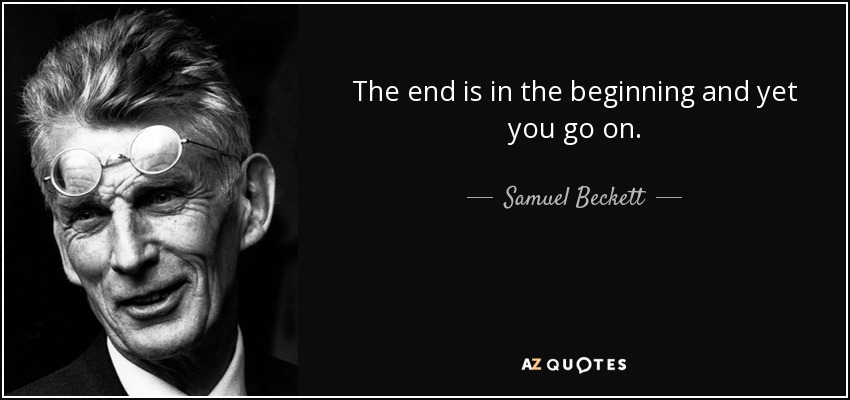
"The End" by Samuel Beckett


“Nothing to be done”

in "The End" by Samuel Beckett


“My way is in the sand, flowing between the shingle and the dune ...hurrying to its beginning, to its end.”

Source:Silence to Silence, a documentary on Beckett


Impassioned, deprived of agency (Petra’s highlight), the old man from Beckett’s novella, “The End,” originally written in French, lets himself be clad and done, on his way out of an unnamed charitable institution, as no more use may be derived from him. Church, hospital, asylum, the place remains uncertain, the man lacks a name, and a string of other unnamed ones, a girl with red braids, an owner, a Turkish/ Greek woman, a boy, a policeman, a man, a priest ... parade the ghostly ride to the end.

“Unreal city, under the fog of a winter down” (T.S.Eliot “The Waste Land”)

The man, well on years, as most of Beckett’s characters are ( “Silence to Silence) walks towards the sought for and inexorable path of his end from the beginning of the narrative (Eva's highlight). The old man, but a shadow, “All I remember is my feet emerging from my shadow, one after the other” (highlighted by Sonsoles ), wears a death man’s suit, and, impervious to the world’s ruthlessness, lives in the small world rather than the big one, as Beckett stated ( “Silence to Silence”), an outcast who wanders through city and countryside in search of a dwelling, a place for self-abandonment.

He feels more identified with the objects that have morphed into his own shape rather than the surrounding human element. A wooden stool bears the shape of his cyst, a bench in the park is indented with his hindside, and the window at the charitable institution has the shape of his eyes. Sleeps in a dung heap, lives in a basement, eager to share the place with a pig, rolls in excrement, brews sores, itches (Sonia’s highlights), pain, physical restlessness keeps him going. Even the crocus he has manured with his own urine has a “wilting stem and a few chlorotic leaves” (page 16).

Despite the dramatic situation of his physical deterioration and isolation, no air of tragedy insufflates the narrative, but just a perfunctory way of facing his destiny. However, some emotional undertones are strewn here and there: a priest offers help, but he does not write his name ( Sonia’s highlight), a man who offers him his abode, and an articulate moment of anger about his son, “that insufferable son of a bitch” (Marian and Geni highlighted this moment):

“One day I caught side of my son. He was striding along with a briefcase under his arm. He took off his hat and bowed and I saw he was as bald as coot. I was almost certain it was he. I turned round to gaze after him. He went bustling along on his duck feet, bowing and scraping and flourishing his hat left and right. The insufferable son of a bitch” (19)

His perambulation not only marks his physical deterioration and stalwart perusal of the end, but it also exposes the cruelty and the disaffection of the many he encounters in his way:

“He was bellowing so loud that snatches of his discourse reached my ears. Union….brothers….Marx….capital...All of a sudden he turned and pointed at me, as at an exhibit. Look at this down and out, he vociferated, a leftover...old, lousy, rotten, ripe for the muckheap” (26) (Nuria and Emma highlighted this passage and commented on it).

An epiphanic moment of social awareness by contrastive output of external perception?

Another contrasting subtlety of the story should not be passed unnoticed as commented on by Cándido and which points to a possible transformative otherness of the old man as a woman. Protean metamorphoses of bodily and situational place: 

"They all refused to take me up. In other clothes, with another face, they might have taken me up. I must have changed since my expulsion from the basement...The face notably seemed to have attained its climacteric. The humble, ingenuous smile would no longer come, nor the expression of candid misery, showing the stars and the distaff."

His final dwelling, a mesmerism, or a real tomb?

“I found a boat, upside down, I righted it, chocked it up with stones and pieces of wood, took out the thwarts and made a bed inside… The sea, the sky, the mountains and the island closed in and crushed me a mighty systole ...The memory came faint and cold of the story I might have told, a story in the likeness of my life, I mean without the courage to end or the strength to go on” (27)


Note: The title to this essay is an echo of  the last sentence in “Waiting for Godot” which also appears in this story ( Sonia’s highlight)


9 Nov 2025

"The Ballad of the Sad Café" by Carson McCullers


Intonations of melancholy in Carson McCuller’s

The Ballad of the Sad Café


 Once upon a time ...

there was a dreary Southern town, imbued with the desertic, thirsty yellow of fading autumnal colours… nothing to do here but listen to the chain gang in the distance. A face, a hand, a shadow lurks behind the window panes of the once lively, but now gone Café. Nothing remains but a half-painted wall, Cousin Lymon gone, and a dismembered heart, Amelia’s.

The whispers of the chatting and prattling community have subsided, and only the narrator’s voice is left to recount in a flashback the events of such a miserable outcome. Tricky narrator, heterodiegetic, omniscient, and unreliable, crooked to the side as the buildings, characters, and hearts (Mónica pointed to the crooked metaphor). A love triangle —Mrs Amelia, Cousin Lymon, and Mrs Amelia’s former husband, released from the penitentiary—comprises the parade of poetic grotesqueries to come. 

Miss Amelia’s marriage to robber and seducer Marvin Macey only lasted 10 days due to some “perchance unholiness” (Sonsoles higlighted this)  on their wedding night. A green-cape-clad hunchback ensues. Amelia, who had love galore in her heart, despite her ruddy nature, softens at the sight of Cousin Lymon’s deformity.

Amelia’s infatuation with cousin Lymon is somehow endowed with the same magic quality that her whisky oozes (Sonia pinpointed this), and explained as “Then Miss Amelia did a rare thing; she pulled a bottle from her hip pocket and ...handed it to the hunchback to drink” (page 14).

The whisky in Miss Amelia’s store has the power of uprooting hidden truths; it is elixir-like and transforms the coarsest spirits.

 Perhaps without it there would never have been a café. For the liquor of Miss Amelia has a special quality of its own. It is clean and sharp on the tongue, but once down a man, it glows inside him for a long time afterward. And that is not all. It is known that if a message is written with lemon juice on a clean sheet of paper, there will be no sign of it. But if the paper is held for a moment to the fire, then the letters turn brown and the meaning becomes clear. Imagine that the whisky is the fire and that the message is that which is known only in the soul of a man -- then the worth of Miss Amelia's liquor can be understood. 

Things that have gone unnoticed, thoughts that have been harbored far back in the dark mind, are suddenly recognized and comprehended. A spinner who has thought only of the loom, the dinner pail, the bed, and then the loom again -- this spinner might drink some on a Sunday and come across a marsh lily. And in his palm, he might hold this flower, examining the golden dainty cup, and in him suddenly might come a sweetness keen as pain. A weaver might look up suddenly and see for the first time the cold, weird radiance of midnight January sky, and a deep fright at his own smallness stop his heart. Such things as these, then, happen when a man has drunk 

The marsh lily anchors itself in dark, silty depths, its roots clutching unseen beneath the surface. Yet it rises through the murk to bloom out of the swamp, radiant in its full beauty. So too the weaver and the spinner, bound to their labor of endless, rhythmic repetition, are gradually transformed under the spell of Amelia’s liquor. Faerie-tale like the story drifts through distant memories that soothe the ache of solitude. 

Cousin Lymon preys, abuses, twists, and tricks Amelia, but love is all-powerful. Marvin Macey comes back to take his grudge due to his unrequited love, and as if a spell was cast, or a curse … (Sonia pointed at this), he mesmerizes Cousin Lymon and subdues him in vassalage (Medieval love). Greedy and sneaky Cousin Lymon is transformed by the sole presence of Mavey. Cousin Lymon’s volatile nature is brandished in the visible lemon traces of his own character, once kindled  by the spark of admiration, infatuation, or perverseness  are visible to the eye.

They both fleece Amelia off love and material richness, shatter her cabinet of curios (Eva pinpointed how Amelia treasures beauty in her small world), and leave her pining and alone, a forsaken lily engulfed by the swamp.

The Ballad of the Sad Café bespeaks thus of the transformative power of love, which, unrequited, lacerates the heart and ensues in the searing loneliness of the human soul. 

All is broken, deserted, torn, cracked, and crooked, only the singing of the chain gang in a coda can be heard, but the "Twelve Mortal Men" dwell outside the story, they are liminal to it.  It is the same chain gang that ushered us into the town and the story but their song has now somehow changed, inviting us to brood with a broader heart about the story of the Sad Café.


10 Oct 2025

"Consumed" by Karis Kelly


The Truth will Out: Intergenerational Trauma in 

Karis Kelly’s Consumed

Karis Kelly's “Consumed” At The Traverse Theatre, Edinburgh Festival Fringe  - The Theatre Times

Source here

“Consumed” by Karis Kelly belongs to what has been deemed “New Writing,” a type of contemporary writing characterized by unconventional and fragmented language, confessional in tone, culturally, socially, and politically committed. Karis Kelly has been awarded “The Women’s Prize for Playwriting in 2022” for this play.

In her acknowledgements, Karis Kelly draws you into the play and to her voice behind the play. She thanks those who have been with her at the helm of this journey, those who have unlocked something vital in her and made her pursue the dream of putting it down in words. She devotes this play to her mother, to all Northern Irish women, “for your grit, your resilience, your way with words. For your humour, generosity and incredible revolutionary spirit … I am so proud of us, of all the conflicting truths we hold, and the peace we have maintained in this island.”

There we were, we, all, a community of voices, in the reading club, Thursday session, Friday session,  attuned, digging out the meanings, and unlayering the words in an enthusiastic unison of getting to the bone of it. We talked about the layering of many worlds (Petra / Celia /Begoña / Miriam) in the play (political, cultural, social, environmental and feminist issues at stake), the historical moments implied (The Troubles, the famine in Northern Ireland), the many identities intersecting, deranged Gilly (Begoña), their family constellations (Geni) about them venting trauma, hiding trauma, the difficulties of the verbal pyrotechnics of theatre in written word (Eva / Nuria) or the easiness of the swift exchanges (Sandra).

Karis Kelly says in an interview that the play has sprung as a necessity to release intergenerational trauma and catalyse, in a cathartic way, an eating disorder she suffered for many years. She mentions in this interview that Northern Ireland has the highest rate of OCD.

The cover of the book illustrates the four generations through four women’s heads embedded in a puzzle:

“I was created in the womb of the womb of women in Ireland” (Muireann, page 61)

The play begins in a realistic, everyday style, lightened by touches of comedy that soften the tragedy beneath. This gentle bathos establishes the mood for the events to come.

The action is set in Bangor, Ireland, but the space is reduced to a house, a kitchen, and four characters. Props perfectly placed, a gleaming surface of order opens the first scene but havoc unfolds towards the end. The house has a human quality of its own, with its cracks and crevices that mirror the cracks and crevices of these four generations of women (Mónica’s comparison with “The Fall of the House of Usher”)

It is Eileen’s 90th Birthday, but the story is not about a Birthday; it is about the tendrils and the roots that spread and lie hidden. 

Eileen has lived through the Troubles, Irish famine; she was an Ulster Scot who changed her religious beliefs for a bowl of soup (Geni / Sonia / Conchi) and does not understand Muireann’s new world of oversized clothes, and gluten-free meals, which she jokes about, “gluten”... is that German? (Belén).

Gilly is trapped in provincial Bangor, “sacrificed herself” for her daughter-- she has sent her to University in London-- lives in the mind, and suffers from OCD, hoarding stuff. She is constantly doing things not to think. They are both part of what Muireeann (4th generation) will call in the play “the wall of silence in Northern Ireland”. Both mother and daughter, Eileen and Gilly, cannot bear to look at each other. Gilly’s husband is off stage, hanging behind a tetris of cardboard boxes that she has herself collected, suicide. The party must go on, and the man remains in the closet; tragedy unfolds. Gilly’s husband partly materializes the uncomfortable hidden truths that are to be obviated, the corpse in the cellar, which echoes that famous Victorian quote: “skeleton in the closet” (Belén) :

“The phrase first appeared in print in the 1816 issue of The Eclectic Review and was used by writers like William Makepeace Thackeray in The Newcomes to suggest hidden, embarrassing family secrets.”Source: here

All the men in the play are absent; it is only Muireann’s boyfriend who accepts her as she is (Emma).

Jenny (third generation) forgets herself in drinking, resents her mother, Gilly, and is cheated by her husband, Ronnan. Muireann (fourth generation) has an eating disorder, is committed to feminism, environmentalism, and political and social awareness. She bears the Irish name that no one can pronounce, lives in London, and feels astride between two worlds. Her eating disorder turns into a metaphor for all the women in the play: hiding, controlling, stuffing the truth inside…

"You suck everything! Consume everything! All the space! All the air"  (Muireann to Jenny, brought forward by Servando)

She believes that intergenerational trauma is passed on through the genes, one could adduce an expiation move rather than a scientific one (Nuria): 

“It is called epigenetics. In between the genes. All the stuff we can’t see. So—so—so, loads of things can be passed down. But they’ve thought for years that this stuff is genetic. Like, they think that there’s maybe a suicide gene...And, maybe, maybe ...an alcoholism gene”

It is precisely Muireann at the end of the play that drags Eileen to embrace the past, to dig out little Robbie’s corpse below the kitchen table, buried during The Troubles after a bullet passed through his throat. Eileen must get in the mud, enter the hole, and see the past in the eyes:

Muireann: “We have to look at the thing. The thing we all refuse to look at… Come on Granny-leen. They starve. You starve. We starve. Us. It. Them. A change in the genes.The carried shame. It goes on and on forever. Don’t you want to end this? It’s me. It’s me that has to carry it. Please! We can end it. Together. For me.

The play ends in a surrealistic way with the "walls swelling and expanding, the ribcage of the house cracking open, all the wounds now letting light through, the house acquiring a human quality to it (Celia / Servando pointed to this surrealistic tone).


18 Apr 2025

Begoña Rodríguez on "Alias Grace"

 “Duplicity versus duality” in Margaret Atwood's Alias Grace
by Begoña Rodríguez


“I felt a Cleaving in  my Mind-

As if my Brain had split-

I tried to match it - Seam by Seam-

But could not make it fit” .       


                                                              Emily Dickinson, 1860        


“The true character of the historical Grace Marks remains an enigma,” said Margaret Atwood, and in the novel, as well. The title” Alias Grace” is chosen by the author on purpose. Grace is the name which appears in the newspapers, Penitentiary records, poems..  Even Reverend Verringer refers to her as “the woman known to us as Grace.”  It is the Grace whose identity or, rather, identities are created by “others.” However, the novel begins with the protagonist and narrator's description of the scene preceding Nancy's murder ,of which she has been convicted. She omits details which can incriminate herself, ”This is what I told Dr.Jordan, when we came to that part of the story.”  She is supposed to suffer amnesia. In addition, the narrator / protagonist uses the name and the persona of Mary Whitney, supposedly an old friend dead a long time ago, on several occasions. So, Who is Grace , has the protagonist a split personality , a dual nature? or is it duplicity? 

Clearly, its free indirect style and the variety of narrative techniques, that is to say, quotes from Primary sources, intertextuality, poems, but, above all, the dual narrative contribute to ambiguity. Thus, an unreliable first person narrator in total control of what she wants to tell and an omniscient narrator, when it comes to Simon Jordan, alternate to construct the story of the female protagonist, an Irish immigrant struggling to survive in a hostile world and eventually convicted of double murder and protected by Double Jeopardy. 

From the start, to the public eye is always Grace Marks. However, the name and persona of Mary Whitney ("white water" in Old English) appears several times during her narrative and comes to Grace's rescue twice, both in private circles: when Grace escapes with McDermott and checks in at the tavern as Mary Whitney and, more importantly , during the Neuro-Hypnotic session at the Governor's with her friend Jeremiah, alias Dr.Dupont, leading the show.  So, pretending to be Mary Whitney saves her life …or is she Mary Whitney?

According to Grace´s account, both women had met at Mr. Alderman Parkinson´s and influences her a great deal. Once Mary dies, so we are told, her spirit is not let out and stays “in” Grace, who shortly afterwards leaves the house. It is now that we see her taking decisions for the first time in her life… Who died there? a woman called Mary Whitney or is it a metaphor for the death of the old Grace.? In other words, is it possible to think that Mary Whitney” dies” at that house, presumably after having an abortion, and a new woman is born? Then, Mary Whitney would be Grace´s alter ego…

Obviously, there is an inner metamorphosis. Grace turns into a learned woman. When she is shown round Mr. Kinnear’s house, she sees two paintings hanging in his bedchamber, one of them has a naked woman wearing a peacock-feather fan, the other, of a naked woman taking a bath, depicts the story of the Apocrypha entitled “Susanna and the Elders.” Interestingly enough, both paintings anticipate what is going to happen to her. The eyes of the peacock feathers and the Elders symbolize the media scrutiny, the pressure, the lies about her private life and the false interpretations of different societal forces and patriarchal institutions. Grace goes through all this alone during the trial and after she is found guilty.”What cannot be cured or avoided must be endured,” she says and…she does. Afterwards, she will also have to put up with all kinds of hardships at the Women's Penitentiary and at the Asylum.

In the end, the Committee, whose members are clergymen and gentlemen of standing, files a petition for her acquittal. Also Dr. Jordan, in love with her, needs to believe in her innocence. Her amnesia and dedoublement could explain it all. But she eludes him, she is out of grasp. Indeed, Grace is a literate empowered strong-willed woman who perseveres in her goal . Her Pardon. After looking at herself in the mirror and mentioning all the things being said about her, “how can I be all of those different things at once?”, she has earned the right to give her own version and gain Absolution and she does everything within her power to be released …. it is a world ruled by men, though.

Against all odds, Grace is set free and appears sewing her quilt “The Tree of Paradise.” She decides to stitch in it and embroider around it three pieces of cloth from Mary's petticoat, Nancy's dress and the prison´s nightdress, which represent all the women of the Penitentiary. They are all part of the pattern of her life. Imperfect as it is, she is the one and only owner.


Mr Reginald Peacock's Day by Katherine Mansfield (2)

  THE IMPORTANCE OF BEING CALLED MR REGINALD PEACOCK by Belén Tizón Source for photo here Katherine Mansfield does not select her main chara...